 |
Archive for the ‘Screenwriting’ Category
Monday, May 21st, 2007
Reader Josh C wrote in with one solution to a problem that’s been frustrating me for months. When you want to save a script as a .pdf, Final Draft won’t always include the title page. It’s frustratingly inconsistent. The obvious workaround is to save the title page as a separate file, which is what I’ve often done. But then you end up emailing two documents, increasing the confusion on the other end.
Josh was using Final Draft version 6.0.6.0. It turns out, the issue is whether the “Title Page…” window is open or closed.
1. Save your screenplay as normal (as a .fdr)
2. With your saved screenplay still open, go to Document > Title Page. A new, blank Title Page opens.
3. Fill in the blanks, then just CLOSE THE TITLE PAGE. This is the part that I got hung up on forever. If you leave the title page open, then try to save as a PDF, it won’t work. The Title page WON’T attach itself to the PDF if the Title Page is still open when you try to Save as. Just close the Title Page. It saves automatically to your screenplay.
4. With your screenplay still open, go to File > Save As — then select Adobe Acrobat Document (*pdf) - or whatever your computer says. Save the new PDF file somewhere and open it up. The Title Page should be attached at the top of the screenplay where it should be 
In my tests with 7.1.3, the .pdf will also include the title page even if that window is still open — provided you have a certain checkbox checked in “Preferences.”
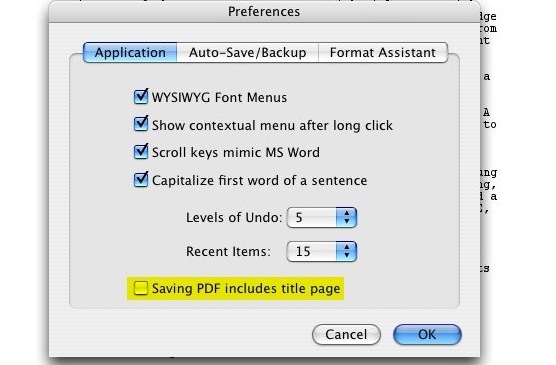 Yes, I’ll admit that I didn’t read the manual with version 7 of Final Draft. But this is a pretty questionable place to put this checkbox. After all, sometimes you’ll want to include the title page, sometimes you won’t. Does it really make sense to have this be an application-wide preference, housed in a panel that has nothing to do with printing, saving or the specific document you’re working on? It’s pretty much the last place I’d think to look for it. Yes, I’ll admit that I didn’t read the manual with version 7 of Final Draft. But this is a pretty questionable place to put this checkbox. After all, sometimes you’ll want to include the title page, sometimes you won’t. Does it really make sense to have this be an application-wide preference, housed in a panel that has nothing to do with printing, saving or the specific document you’re working on? It’s pretty much the last place I’d think to look for it.
What’s more, at least on the Mac, Final Draft is using the built-in .pdf facility of OS X. It’s basically just printing to a file. Since it seems to be using the standard print architecture, you’d think that choosing the “Print Title Page” option in the Print dialog box would have some effect. It doesn’t. And that’s why it’s frustrating.
Whenever I complain about Final Draft, I get a nice note from the developers asking me to help out with the next version, and a few emails from companies working on competing applications. So let me make it clear where I stand. Despite its annoyances, I end up using Final Draft because what it gets right generally outweighs what it gets wrong. There’s certainly some inertia on my part, but given a better alternative, I’d switch in a heartbeat. The shipping versions of Screenwriter, Montage and Celtx aren’t better, particularly when it comes to revisions.
I’m hoping the upcoming Screenwriter 6 gives Final Draft some real competition, because that’s what’s lacking. When we were cutting The Nines, I realized that editing software has benefitted tremendously from the battle between Avid and Apple, with new features, better interfaces, and dramatically lower prices. I started out a Final Cut Pro man, while my editor was firmly Avid. We had the luxury of both being right. Both systems are terrific, and I think that’s largely because of the competition.
Posted in How-To, Screenwriting | No Comments »
Monday, May 21st, 2007

After last week’s wonkfest regarding the WGAw’s foreign levies program, I suspect of number of you passed out from boredom.
Forgiveness, please. Things will continue to get wonky around here as we get closer to negotiations and possible strikes, but that doesn’t mean it’s all doom and gloom.
For instance, this week I’m serving clams.
According to Jane Espenson, clams are one-liners or comic concepts that have gone stale from overuse. Now, that was a new one on me. I knew the term was used in music for a bum note, and for the ultimate usage in that context, one need only review a transcript of just one of Buddy Rich’s infamous rants at his band (in this excerpt, it’s the trombonist getting the brunt).
You’ve got your f—kin’ horn so far deep in the f—kin’ bell, we don’t need to have a band here tonight. You afraid you won’t be heard? Everybody can hear your f—kin’ clams out there. You don’t need a mike for that. You’re takin’ up too much f—kin’ time blowin’ what? Shit!! You stand out here all night tryin’ to blow your f—kin’ brains out… when it comes time to play, what do you play? Clams!! You got nowhere to f—kin’ go tonight the next set because if I hear one f—kin’ clam from anybody, you’ve had it! One clam and this whole f—kin’ band is through…tonight!!
Yeah, Buddy was a real sweetheart.
Anyway, anyone who writes comedy for a living has written a clam, but we all recognize that they’re awful, and so when we’re together in a room, we’re supposed to keep ourselves from using them. In my room, we usually call them “badump bumps,” but I think Jane’s got a better, clammier term.
Here’s a short list I came up with, as well as some additions from friends. Feel free to use the comments section to add your own. As for definitions, I’m pretty lenient. It could be a single line of dialogue, or it could be a setup and payoff.
Maybe if we shine enough light on these things, we can eliminate them from the world.
The Inside Voice: “I’m sorry…did I say that out loud?”
The Freudian Slip: “Hey, Carol, I see you’re wearing some new boobs…I mean boots!”
The “Mr.” Insult: “Oooh, check you out. Mr. Big Man! Mr. Crazy hat-wearing guy!”
The Nutty List: “All I know is I want to eat a steak, get laid, and play some golf…not necessarily in that order.”
Dante’s Clam: “This is the date from hell!”
Albert Hoffman’s Clam: “This is like Ice Capades on acid.”
The Apollo 13: “Houston, we have a problem.”
The Ignored: (as the character is being talked about) “I’m standing right here…”
The Fork-Dropper: “Check please!”
The Optimist: “Well, I thought that went pretty well…”
The Invisible Puke: “I think I just threw up in my mouth a little.”
The Dismissive Segue: “Anyway….” (typically after another character goes off on a long, complicated rant)
The Factory: This is a visual one. Someone gets hurt in a factory, and a worker flips the “Days Since An Accident” sign back to 0.
The Upward-Looking Rejoice: “Thank you, God!”
Okay, now it’s your turn, li’l clamsters. As they come in, I’ll cull and add your contributions here in the main article.
Posted in Screenwriting | No Comments »
Friday, May 18th, 2007
 After dreaming of publishing my own stories, either in screenplay form or novel, I finally landed a job writing for a local alternative music publication. With a year of deadlines, word counts, and earning endless scorn from my editor (who I am convinced possess more red ink than blood) under my belt, I now feel comfortable beginning the process of flushing out these stories in a structured form. After dreaming of publishing my own stories, either in screenplay form or novel, I finally landed a job writing for a local alternative music publication. With a year of deadlines, word counts, and earning endless scorn from my editor (who I am convinced possess more red ink than blood) under my belt, I now feel comfortable beginning the process of flushing out these stories in a structured form.
My question is: Which format should I pursue?
Through your site, I now understand the plus and minuses of writing a screenplay. And, I take heed into delving into the business end of screenwriting. (I enjoy living in Florida and have little desire to pack up for L.A., at this time.) Also, some of my ideas just seem easier to tackle for a first time screenplay than a first time novel, such as my quirky rom-com outline rather than my existential mind bending sci-fi epic. Finally–not to belittle the screenwriting process–there are some stories that I feel more comfortable sharing credit on the final product compared to other stories I feel so strongly about that I want to collaborate with no one.
I know your personal answer would always be a screenplay. But, have you ever read a friend’s or fellow professional’s script and advised her material is best suited as a book? For what reasons? And, what format would be best for a (semi) unpublished writer? (For some reason, the Premiere magazine feature on Rex Pickett and his struggles to sell “Sideways” as a screenplay keep popping in my head.)
I searched your archives and could not find a similar question to answer my query. If I missed it, I apologize.
– Mike Rabinowitz
Head Writer
REAX Music Magazine
Assuming you enjoy novels, you should probably write one, rather than writing a screenplay.
I know that seems like heretical advice for a blog about screenwriting, but I think the numbers support me. In the U.S., more than 3,500 novels are published each year. Compare that to film: For 2006, there were 607 movies released theatrically.
If you’re looking to put your story out into the world, paper beats film, hands down.
Beyond the hard numbers, consider the relative levels of authorship. Novels are a final art form — you write a book and that’s it. It sits on a shelf with your name on it. Screenplays, on the other hand, are one link in a long process leading to the final art form: a movie. While it’s your name on the script, the movie is the result of a huge collaboration. Right or wrong, the director will get most of the credit for what makes it on screen.
So why would anyone write a screenplay?
Based on questions my readers send in, a couple of scenarios come up frequently:
To get rich. Often, when you read about a new script, the story has a dollar figure attached: “Joe Smoalan sold his spec MONKEY BUTLER to New Line for high six-figures.” One you figure out that “high six figures” means more than $500,000, you realize that there’s a lot of money to be made in screenwriting. Most of the authors you find on the shelves of Barnes and Noble aren’t making that much money. “I could never write a novel, but…” Because screenplays have fewer words than a novel, they should be easier to write, right? Besides, everyone’s seen bad movies. It can’t be hard to write one better than The Grudge 2. “I could never direct a movie, but screenwriting is just words.” So much of moviemaking is esoteric and intimidating. Just watching the end credits scroll by is bewildering to anyone outside the industry — who rated the men to pick the Best Boy? But it’s not hard to imagine writing a script. It’s just words and margins.
It will surprise no one when I point out that these are three terrible reasons to write a screenplay.
We’ll start with the money. I get frustrated when journalists treats screenwriting as a kind of lottery, emphasizing the payday rather than the work. Most scripts never sell, and most scripts that do sell, sell for a tiny amount. The reason why you read stories about million dollar sales is because they are pretty infrequent.
In terms of the “I could never write a novel” excuse, yes, some writers seem better suited to one kind of writing than another, just as most painters aren’t sculptors. But creating characters, shaping storylines, and stringing together words in a pleasing fashion are prerequisite skills for both novels and screenplays. I would lose respect for any working screenwriter who professed an inability to write traditional fiction.
It’s true that the learning curve for screenwriting isn’t as steep as it would be for, say, directing. And it costs a helluva lot less. But a screenwriter quickly finds that maintaining a willful ignorance about the moviemaking process is impossible. In order to get your film made, you’re going to have to learn about the physical and political ordeal of production. You can do that in school or on the set, but you’ll soon know your grips from your gaffers.
So back to the original question: Should you write a screenplay or a novel?
The answer is a question: What does your idea want to be?
Do you envision an intimate psychological profile of a half-Korean woman trapped in a mediocre marriage who imagines an affair with her co-worker? That’s probably a novel. The story is largely internal; the action is minor; the stakes are low. In the novel version of your story, you can spend a paragraph detailing her decision to buy percale sheets, describing the different textures and comparing them to the geography of her homeland. In the movie version, she buys sheets, and maybe has a conversation during the process.
Are you looking to write a comedy about a deposed crime boss who goes into witness relocation at a fat camp? That’s a movie. Here’s a test: Can you envision a one-sheet poster? It’s a movie. Could it star Martin Lawrence? It’s a movie. Could you describe it as “something meets something?” (e.g. SOPRANOS meets SISTER ACT) It’s a movie.
What happens if you have a novel-worthy idea, but you’d rather write a screenplay? Tough. Don’t make the mistake of trying to force it into screenplay shape. Yes, some books can be adapted into great movies, but it’s because they inherently had enough cinematic content to make the leap. If yours doesn’t, you’ll only frustrate yourself and your readers.
Posted in Adaptation, Genres, Screenwriting, Words on the page | No Comments »
Thursday, May 17th, 2007
 How come I get all my best ideas when I’m jogging? Any experience with this phenomenon? How come I get all my best ideas when I’m jogging? Any experience with this phenomenon?
– Ben
Los Angeles
It’s because your brain hates you.
Well, maybe not hates. After all, it is giving you what you want — a good idea. It’s just that its timing is atrocious. It’s like having a girlfriend who is only in the mood for love during the last 20 minutes of Lost. You have to choose between sex and seeing the underwater station for the first time.
Here’s my advice: always choose sex. Because if you don’t, eventually, you’ll stop being offered it.
Those great ideas that come while you’re jogging? Write ‘em down or you’ll lose them — and worse, you may dry up the well of ideas. If your brain notices you’re not paying attention to the good ideas it generates, it may decide to stop bothering. And then you’re screwed.
So always carry a pen. Pick up a piece of paper trash. Write on your hand if you have to. It’s often just one or two words which will let you remember what the idea was.
For me, the majority of these inconvenient ideas come at 11:30 at night, as I’m trying to fall asleep. There’s a weighing process as I decide whether it’s worthy of hauling my ass to the bathroom, where I keep a notebook handy to scribble down these ideas. Probably 70% of the time, I do get out of bed. At least half of the “big ideas” in The Nines were first scribbled down in this book, along with the plots of enough unwritten movies to keep me busy for a decade.
This is part of what sucks about being a writer. I have a hunch that accountants don’t have this problem.
Posted in Screenwriting | No Comments »
Tuesday, May 15th, 2007
In case you’re wandering La Croisette, wondering where all the interlocking three-part dramas with unexpected science-fiction elements are, you might want to check out The Nines, which has three market screenings scheduled this week:
- Wednesday, May 16th at 12:00pm - Palais K (Market)
- Friday, May 18th at 8:00pm - Palais K (Market)
- Monday, May 21st at 11:00am - The Deauville / Majestic Hotel (Market)
We’re not in competition — these screenings are just to give distributors in, say, Bulgaria, a chance to see the movie. I’m not there, so I have no particular insight on how to muscle one’s way into these screenings, except that persistence almost always pays off.
This is also a unique opportunity to see the movie with its sparkling new French subtitles:
- MARGARET
- Je suis à ça de t’avoir Christine Walsh pour Parade Magazine.
- GARY
- Je déteste Parade Magazine.
- MARGARET
- Tout le monde déteste. Le public de “Crime Lab” adore leur Marilyn Vos Savant. Fais-nous un petit acte de contrition, et peut-être qu’on tuera pas ton personnage. Va pas me faire un pétage de plomb…
- GARY
- Je suis pas fou.
- MARGARET
- Justement. Justement!
Posted in Screenwriting | No Comments »
Friday, May 11th, 2007
Some of you have been struggling with formatting in the comments section.
Some tips. Normal line breaks are fine...the program knows to format them as such.
For italics, enclose your words in single asterisks.
For instance, *these words* will become these words.
For bold, enclose your words in double asterisks.
**These words** will become these words.
The asterisks trick only works up to a line break, though, so if you start a new paragraph, enclose each paragraph in the asterisks if you want to italicize or bold.
Of course, standard HTML tags work as well.
Posted in Miscellany | No Comments »
Tuesday, May 8th, 2007
 I’m sure this is an unusual type of email, but I am doing some footwork for a friend of mine who wants to be a script doctor and doesn’t really know where to start. Right now he has a degree in English - Creative Writing and some film classes under his belt, but no experience in the industry. Can you offer some quick advise to someone looking to break into the field? I’m sure this is an unusual type of email, but I am doing some footwork for a friend of mine who wants to be a script doctor and doesn’t really know where to start. Right now he has a degree in English - Creative Writing and some film classes under his belt, but no experience in the industry. Can you offer some quick advise to someone looking to break into the field?
– Heather
Actually, this basic question comes up a fair amount, so it’s time I explain a term of art:
SCRIPT DOCTOR
An established screenwriter with significant credits who rewrites a script to address specific concerns, often shortly before production begins.
By this definition, I am a script doctor. I get brought in to help out on big expensive movies — two of which you’ll see in Summer 2008. They pay me significant money to do a few weeks’ work, for which I’ll never get credit. I’m hired for my talent, hopefully, but also my track record in getting movies up on their feet. I enjoy the work, partially because it’s a chance to date other movies while being married to the ones I’m “really” writing.
The thing is, no one who actually is a script doctor uses the term. My hunch is that some journalist made it up, likely because the work the screenwriter is doing on a script in this stage is often described as “surgical” — you’re going in to fix a very specific issue, and leaving everything else intact. Steve Zaillian is often brought up as script doctor, but make no mistake, that’s not a side-job to his writing career. It is part of his writing career.
To summarize, Heather, a script doctor is a screenwriter. So if that’s your friend’s goal, he needs to write a lot of scripts and have them produced. There are also non-writers involved in the process of shaping a story — producers, development executives — but their focus is working with a writer. If that’s his ambition, he’ll start out in the trenches, answering phones and writing script coverage.
UPDATE:
Damn, I knew I’d answered this before. In fact, it’s the fifth hit on Google for “script doctor.” Here’s what I said in 2004:
In the industry, a script doctor is an established screenwriter with a bunch of credits who comes in on a project shortly before production and does a rewrite to fix some specific, nagging problems. (Or, depending on your perspective, destroys the things that made the project unique.) Steve Zaillian is a highly-regarded script doctor. Arguably, I could be considered a script doctor, because I’ve done a fair number of these 23rd-hour emergency jobs. But no one’s business card reads “script doctor.†It’s a specific task within screenwriting, but not really a profession in-and-of itself.
A lot of times, the work you do on these projects is described as “surgical,†which fits well with the script doctor moniker. Generally, you’re not rewriting the whole script. You’re fixing a few key sections that aren’t working.
It’s strange to read an answer written nearly three years ago and see the same phrasing, same examples. I guess it’s good that I’m consistent.
By the way, I’ve added this to the wiki, in anticipation of the next time someone asks the question.
Posted in Education, Film Industry, Q&A, Recycled | No Comments »
Monday, May 7th, 2007

Conspiracy?Some people are obsessed with the grassy knoll. Others are sure that 9/11 was the first time fire ever melted steel (except for every single day in every steel mill in Pennsylvania, but hey, Rosie O’Donnell knows best).
In the WGA, there’s only one conspiracy theory worth talking up, and lo and behold, it’s the strange case of Foreign Levies.
This is gonna be a long one, folks, so bear with me.
Last week, no less than three articles were published about this topic. The Los Angeles Times, Fade In Magazine and the L.A. Weekly all weighed in, and with varying degrees of accuracy and sensationalism. Prior to this, I guess the only person really interested in this topic (who isn’t a conspiracy theorist) was me. I wrote an article about foreign levies, and if you want the rest of this piece to make sense, you should probably go read that first.
Before I go into my analysis of the current brouhaha and the players involved, I should note for full disclosure that I spoke with Richard Verrier (the author of the L.A. Times article) on background, and I went on record with Stefan Avalos, who wrote the Fade In article.
Here are some facts.
In 2005, a class-action suit was filed against the WGAw, with William Richert as a named plaintiff, alleging that the WGAw had no legal standing by which they could collect foreign levies, and furthermore, they weren’t distributing them.
Also, a former staff employee at the WGAw named Terry Mial was recently fired. Mial, who had been working in the department that distributed foreign levies, is suing the WGAw for wrongful termination.
One last fact. There are some people who believe that the entire foreign levies program is a massive scam designed to steal money from writers and divert those funds into the pockets of highly placed Guild employees and political muckety-mucks.
I think Verrier wrote a very balanced piece, which you can read here. Avalos also did a very thorough job, and I also found him to be extremely balanced and fair-minded. You can read his piece here (the layout is odd…his article starts on the right side, but once you get past the first bit and hit “continue”, the formatting improves).
And then there’s Dennis McDougal at the L.A. Weekly. His article was awful. I understand that the L.A. Weekly doesn’t exactly “do” journalism the way everyone else does…his piece is a hybrid of reportage and opinion…but it’s such a nightmare of misinformation, it belongs happily nestled between ads for prostitutes and pitches for laser vaginal rejuvenation.
Hey, the L.A. Weekly’s gotta make money somehow…
Anyway, I think all of this publicity was precipitated by a recent court ruling in the Richert case. The Guild, represented by General Counsel Tony Segall, argued that the case should be heard in federal court (nb: Tony is really the WGAw’s outside counsel, but ever since the in-house general counsel was summarily fired by Patric Verrone and David Young, Tony has served as outside and inside counsel, an arrangement that makes me a bit squeamish, although I continue to hold Tony in high regard).
The guild wanted the case in federal court, because it apparently believed it would prevail on the basis that they had not violated the Labor Management Relations Act. See, part of the plaintiff’s anger is at the fact that the WGA and DGA share the foreign levies with the MPAA companies. The WGA wanted the case to be heard on those grounds in federal court (which governs the LMRA), because they were pretty sure they hadn’t violated that law.
And they probably haven’t. However, the judge turned down their request, and remanded the case back to the California courts, because:
Plaintiffs here do not allege that defendants breached their duty to collect or disburse foreign levies under the agreement. Rather, they allege that defendants have illegally converted funds that rightfully belong to plaintiffs by holding themselves out as having the right to collect foreign levies on behalf of non-members without having obtained the non-members’ authorization to do so.
Got that? The judge is saying, “The guys aren’t saying you screwed up by making a bad contract under labor law, they’re saying you screwed up by collecting this money in the first place without asking permission from the people on whose behalf you’re doing this.”
As to whether some limitation of rights occured (which is central to the question of whether or not the plaintiff’s case has merit), the judge said:
By providing that the Guilds would receive less than 100% of the author’s share, the agreement clearly limited plaintiff’s right to receive their full share of the foreign levies. The court therefore concludes that the agreement contains ‘clear and unmistakable language’ circumscribing plaintiffs’ rights.
This is certainly true. If you live in Europe and write a movie there, you retain copyright, and you get 100% of the foreign levies due the author of that movie (which would be 50%, actually, since the director gets half…I think…this may vary from country to country). Through their efforts to get that money out of Europe and into our hands here in the U.S., the DGA and the WGA had to deal with the fact that the talent are authors there but not authors here. Hence, the compromise to avoid litigation that led to the 50-50 split with the companies.
It’s important to note that while the Judge believes the agreement circumscribes the plaintiff’s rights, I don’t think her ruling implies that it does so illegally. That’s still up to the state courts to decide…although I must remind everyone that I’m a layperson. I’m playing the home game along with the rest of you.
As an aside, the plaintiffs sought legal fees from the WGA, but the judge didn’t grant those, because she felt the WGA’s position wasn’t frivolous.
As for Terry Mial, here’s what we know. We know that she claims to have complained a lot about the way foreign levies were being disbursed. We know that she alleges that she was cooperating with a Department of Labor investigation (although there’s no other evidence to date that such an investigation exists, formally or otherwise). Lastly, we know that she told a coworker to keep quiet about the alleged investigation or “I’ll have to kill you.”
Joke? Threat? I have no idea. It got her fired, though, and she’s charging that her termination was retribution for whistle-blowing, rather than murder-threatening. I do know that under Patric Verrone and David Young, the WGAw has become a fire-happy termination festival, with heads steadily rolling since they took power. Some of the costs of that sort of management style are resentment and lawsuits.
Reap/sow, etc.
Personally, I think you probably do have to fire anyone who makes a serious death threat. Let’s see how that case winds up.
Before I get into what the L.A. Weekly article got wrong, let me first talk about what I think the critics of the foreign levies program get right.
The star of McDougal’s article is Eric Hughes, former Guild candidate for President and general WGAw gadfly. I think Eric is a bit unhinged about all of this, and I know he’s certainly wrong about some things, but all in all, I don’t blame Eric for any of his more…shall we say…exciting theories about foreign levies.
It’s the L.A. Weekly’s fault for publishing them without checking facts.
Still, there are some things about foreign levies that trouble me.
First, while I’m basically on board with the concept that without the WGA stepping into the breach, none of this money would find its way to us, I’m growing increasingly impatient with the guild’s inability to do the job competently. It’s not the baloney accusations about “hiding money from easily-found widows” that bothers me (most of that stuff isn’t true, e.g. I hear that Preston Sturges died intestate, his heirs are apparently battling for his money, so the guild doesn’t know to whom his levies should go).
I’m more concerned about the bureaucratic inefficiency. Granted, the Guild was swamped by more money than it knew how to distribute, and granted, the paperwork it often gets from the foreign countries is insufficient or nonexistent. Still, you shouldn’t take on a job if you can’t do it right. While things are getting better, they’re not what I’d call “good.” If the Guild can’t manage to clear out all of the funds it’s holding within two years, it should wave a white flag and give someone else a try.
Second, according to the guild’s own internal investigation of the foreign levies money, $17,000 is missing. Unaccounted for. They’ve turned the results of their investigation over to the police, but how could this have happened at all? Where are the safeguards and procedures to prevent what sounds like outright embezzlement? While $17,000 is a pretty small amount in the grand scheme of the many millions that foreign levies bring in, it’s still seventeen thousand dollars.
I think the membership of the Guild deserves to know who, if anyone, is being investigated, and who, if anyone, has been put on leave or suspension over this incident. It’s incredibly embarrassing and disconcerting, particularly in light of the fact that the conspiracy theorists insist that people are stealing money hand over fist from foreign levies. I keep saying “No, there’s no proof!”, and now, apparently, someone has stolen some money. Arghh. If you can’t keep the cash safe, then stop collecting it.
Third, and why Hughes and Co. don’t spend more time complaining about this I don’t know…is the foreign levies deal with the MPAA a collective bargaining agreement or not? If it is, then why didn’t the membership ratify it through a vote? Our constitution clearly sets out the circumstances under which collective bargaining agreements should be ratified, and I think the language is incredibly clear: all CBA’s must be ratified, in one way or another, no matter what type they are or function they serve.
If the deal isn’t a CBA, then was the WGAw, as a labor union, legally entitled to make it?
Fourth: When I spoke with Patric Verrone to learn about foreign levies, he told me (accurately) that if the Guild doesn’t shift undisbursed levies into the union’s general fund after seven years, those funds would escheat…or default…to the state.
Here’s Avalos on that.
Keeping undistributed money from escheating to the state seemed a reasonable attempt to keep it safe for the writers not yet found, especially if “escheat” were synonymous with “forfeit.” Unfortunately, that was not the case.
Folks, I certainly thought escheat was synonymous with “forfeit.” I was wrong.
According to the California state controller website, “The Unclaimed Property law was enacted to prevent holders of Unclaimed Property from using your money and taking it into their business income. This law gives the State an opportunity to return your money and provides California citizens with a single source, the State Controller’s Office, to check for Unclaimed Property that may be reported by holders from around the nation.”
Hmmm. Okay, but all things being equal, why let it escheat?
And unlike the WGA’s five percent administrative fee, the state charges nothing to a claimant. Its service is free.
Oh. Right. Hmmm, not good.
Wouldn’t it therefore have made more sense for the WGA to let the unclaimed money escheat instead of holding on to it?
Well, from the perspective of a recipient of those funds, I think yes, yes it would make more sense to let the funds escheat.
Eric Hughes questions the legality of the guilds’ policy of keeping the money: “Unions do not have to allow money to escheat if it’s ‘dues-able’ … Once the member dies, the member no longer pays dues, so that money must escheat. Money for nonguild [members] has to escheat immediately.”
I’m not sure if his legal analysis is correct or not, but I think he’s on to something. It’s not necessarily good for the union, but it’s probably the right thing to do. Frankly, why shouldn’t members’ money escheat if the WGAw can’t find them or doesn’t know to whom it should actually go?
Contradicting the 2003 WGA newsletter, Segall denies that any principal amount of undisbursed money has ever moved from the levies fund into the general fund. “The only money that has ever flowed into the general account is interest on the money held in trust and, in the last couple of years, the five percent administrative fee.” Segall wouldn’t elaborate on how money, undelivered for more than seven years, had avoided escheatment, but felt the guild was handling it properly.
Ouch. I hate reading stuff like this. I don’t like it that our union put out a statement in 2003 that our general counsel is now saying is false. I also don’t like it that Tony is claiming that money that should be escheating isn’t escheating and not because it’s in the general fund, but he’s not gonna say how the WGAw is doing it, but it’s “proper.”
I generally give Tony and the union the benefit of the doubt, but I think after misplacing $17K, losing a fight in federal court, getting slapped with a wrongful termination lawsuit and contradicting union publications, I’m owed a better explanation as a member. I think we all are. We should know exactly why the WGAw isn’t letting the money escheat, and we should know exactly how the WGAw isn’t letting the money escheat.
This is why, in a way, I’m happy that guys like Eric are around. Does he seem to have an irrational vendetta against the WGAw? Yes, he does. Is he right about everything he says? No. Is he occasionally right? Yes. Is anyone else as publicly assiduous in their attack? No.
Eric is like a car accident. You don’t deserve to get hit by another car, but it’s one of the only ways you’ll find out if your airbag is working, ya know?
Still, like a car accident, conspiracy theories don’t care whom they hurt. Nor do the proponents of conspiracy theories care for truth. They begin with assured, preconceived notions, and then build cases.
That’s why they say silly things a lot.
(Ed. Note - 5/10/07 - I’ve now had a lengthy discussion with someone close to Eric, and as a result of that discussion, I wish to offer this limited apology to Eric Hughes.
Eric…if you’re reading this…I’ve unfairly associated you with some people who purport to speak on your behalf. I understand now that they do not, and will no longer tar you with that brush. My apologies.)
Here are some excerpts from the L.A. Weekly article that I find objectionable.
Since 1990, these critics contend, the guild has quietly been paying a king’s ransom in writers’ foreign earnings—far beyond the $20 million in withheld checks already acknowledged by Gor—to powerful Hollywood entities without the writers’ agreement or knowledge.
I think what “these critics” are contending is that the writers share in foreign levies money with directors and the MPAA companies. This is a matter of public record. Hell, I’ve written about it here on my blog. It’s possible that writers don’t know about it, the way that many citizens haven’t read the 9-11 Commission report, but that doesn’t mean that fact is being hidden, nor does it justify the use of the word “quietly” in the above paragraph.
The L.A. Weekly has learned that the Department of Labor has been quietly gathering evidence and testimony about the guild’s payment practices for over a year—though it refuses to confirm or deny that it is investigating.
Uhhh…..huh? If the DOL refuses to confirm or deny it, then how does the L.A. Weekly know this? If they have some evidence, why not share it with the rest of us? Why should Eric Hughes and some guy at the L.A. Weekly enjoy the privilege of that knowledge while the rest of us dues-paying schmoes get left out in the cold? If the DOL is investigating the Guild and there’s evidence of it…PUBLISH IT!
If not…why allege it without evidence?
Moreover, on April 12, a 27-page ruling by Los Angeles federal District Judge Margaret Morrow appears to have granted the writers some legitimacy, by rejecting the WGA claim that, as a labor union, it could collect and hold their money—and charge them hefty fees to boot.
I’m not sure that’s what the ruling said. There’s some tricky wording there…re: “as a labor union.” The WGA may still prove a right to collect and distribute (and hold, I suppose) that money, but outside of the federal statutes specifying management-labor relations. That’s the reason there’s still a trial yet to come. This seems unnecessarily misleading to me.
The controversial but, to many, compelling argument made by Hughes, Richert and other critics is that foreign levies are being withheld by all of Hollywood’s talent guilds in a long-standing practice they see as a bizarre twisting of U.S. copyright law.
That virtually unnoticed 1990 decision, by the guild’s board of directors, to funnel more than 90 percent of American writers’ foreign earnings to big studios and other fat cats, mirrors an old practice struck between screenwriters, actors, directors and the studios in the 1940s shortly after the WGA, Directors Guild of America and Screen Actors Guild were born—and conceded authorship of the movies they created to the studios.
Boy, where to begin on that doozy? I’m glad that an alleged “many” find Eric’s argument compelling. First off, Eric’s premise is incorrect. He believes that writers and only writers are due the foreign levies from movies and television. My understanding is that many countries (if not most) recognize that directors and writers share in the authorship of film and television.
Next, who needs pointless language like “fat cats” in there? “Fat cats?” Really? That’s how journalism goes these days? Anyway, the numbers are off. The early levies deals were bad, but they’ve grown increasingly better. Currently, writers are due 25% of foreign levies. The directors get the other 25%, and the AMPTP gets 50%. I’d like to think that when this deal expires, the breakdown will be even more favorable.
The truly big whopper in the above excerpt, though, is this nonsense about the guilds ceding authorship to the studios in the 40’s. Work-for-hire, the uniquely American quirk of copyright that allows a corporation to commission a work and retain copyright, has been applying to motion pictures since 1912, not the 40’s. Decades before the Guilds ever came into existence, Congress ruled that motion pictures (yes, they specified them) fell under work-for-hire. They don’t have to be created under work-for-hire, but they can be.
Because work-for-hire existed, screenwriters and directors couldn’t exercise copyright claims, nor could they license their work. They were, by dint of work-for-hire, employees. And guess what employees can form?
Unions.
The unions didn’t give away copyright to the studios. They unions were only possible because work-for-hire had already been introduced thirty years prior.
A furious Mial started smuggling out of the gleaming glass WGA headquarters records of “undeliverable” foreign levies—essentially, piles and piles of payment records and mysteriously uncashed checks reviewed by the Weekly, which she claims she rescued from the guild’s shredder.
“Gleaming glass?” Jesus, McDougal…have you seen the place? Gleaming? I guess gleaming sounds more evil or something.
I like the quotes around “undeliverable.” Beats having to write out “allegedly undeliverable,” which is accurate and responsible, but not as much fun.
By the time she left last June, she says, the bookkeeping had become so egregious that checks were cut, held for several months, then declared “undeliverable”—after which they were escheated back into WGA bank accounts, allowing the known totals of undelivered payments to swell far beyond $20 million.
Either she’s right, and the Guild is in serious trouble, or she’s really bad at figuring out what’s going where, in which case it’s probably for the best that she got fired.
Until her own death last November, Preston Sturges’ widow, Sandy, had been equally outspoken. At the same time that the guild invited her to unveil its new Preston Sturges Reading Room at the WGA West headquarters at Third and Fairfax in the summer of 2005, her late husband’s name appeared among the long roster of “undeliverables” in the guild’s foreign-levies division. Mial testified in her deposition in the Richert case that she knew of at least one check for $5,000 that Sandy Sturges was never paid—and had documents proving it, which were obtained by the Weekly.
As mentioned above, Preston Sturges died intestate. This is a bad example to keep banging on, because it’s the easiest one to explain away.
But in exchange for a large up-front payday and the promise of future residuals, all of Hollywood’s guilds “assign” copyright to studios, and have done so for more than two generations.
A massive untruth. The Guilds do no such thing. You know who “assigns” copyright to the studios?
We do. The writers. By our own choice. Me, Ted, Eric Hughes, all of us. There’s nothing stopping us from insisting that we retain copyright on our spec scripts, agreeing only to license the movie rights. Completely kosher, and we wouldn’t even have to pay the Guild dues.
Problem is that the studios won’t do business like that. They refuse. The Guild’s MBA is the minimum agreement we follow when we choose to abide by the studio’s terms. It is not some institutional infringement of our rights in any way.
Guild vice president Carl Gottlieb, in a posting to a popular WGA members’ blog called Writer Action, says the foreign-levies diversion scheme was originally hatched in 1990 by two studio lawyers and then-WGA executive director Brian Walton.
Carl isn’t the VP of the Guild. David N. Weiss is. WriterAction ain’t that popular (I’m just being bitchy now, but honestly, it’s the same 30 people talking over there), and the foreign levies program really isn’t a “diversion scheme.” That’s laughable. I guess the L.A. Weekly is a “print ‘journalism’ scheme hatched to lure men to so-called ‘massage’ girls who advertise in the smeary-inked pages.” Sigh.
“Under labor law, ratification is not required,” the WGA’s Segall tells the Weekly. “We don’t read it as requiring ratification.”
Hughes maintains otherwise, saying, “No union has the right to go in and negotiate without the consent of the membership”—not to mention nonmembers or the heirs of dead members.
See, this is what’s frustrating about Eric. He should follow this line of inquiry. Not the baloney moustache-twirling “save the widows from the Gleaming Glass Fortress” stuff. I think Eric has a real case on this point. And it’s not labor law that’s relevant. It’s the WGAw constitution, which is a binding contract between the union and its own members. The constitution demands ratification, regardless of whether or not the law says you don’t have to do it.
But in the end, after all this hullabaloo, here’s the messy truth, far from the world of accusations of theft and evil and so-forth.
The messy truth is that foreign governments collect money for the authors of movies and TV.
Those of us who work in Hollywood are and aren’t the authors of these things. We are in name, we’re not in law.
The foreign countries don’t recognize that corporations can hold copyright.
On the other hand, once the money crosses our border, our laws apply.
Big mess.
One day, maybe they’ll work this all out in The Hague. Given the nature of the international wheel of justice, I figure it will all be settled by 2040, after a few hundred million in legal fees.
What the WGA, DGA and MPAA did was a smart compromise.
Unfortunately, it might not hold up in court.
If it all collapses, we will lose. Of that much, I’m sure. Hughes and Co. believe that the money will finally flow directly to us, and they’re wrong about that. It will be a massive legal battle, and God only knows what we’ll get.
In that sense, I hope they fail.
On the other hand, institutions can’t expect to to build a house of cards in service of a good ideal, because those things never last. Bad structures inevitably fail. It may be that the Guilds’ foreign levies structure is fundamentally flawed.
In a year or two…or fifty…we may find out.
Posted in WGA Issues | No Comments »
Monday, May 7th, 2007
One benefit of leaving the comment threads open is that sometimes a long-dead post gets a surge of new activity. Over the past month, I’ve noticed a few new comments on a 2004 post featuring this photo…
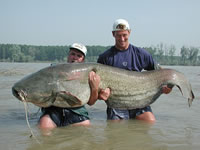
…which is, according to Snopes, probably real in the sense that it’s not Photoshopped — though it’s probably not a catfish, and the fishermen may not even be American. (Imagine!)
I originally used the image because it bears an uncanny resemblance to the final incarnation of Edward in Big Fish.
Posted in Big Fish, Follow Up | No Comments »
Sunday, May 6th, 2007
Like several million people worldwide, I saw Spider-Man 3 this past weekend. And like a substantial percentage of these viewers, I got frustrated by the number of unlikely coincidences in the movie.
There’s nothing wrong with coincidence, per se. Almost every movie is going to have some incidents where one character just happens to be in the right place at the right time. In fact, many movies are built around a “premise coincidence.” In Die Hard, John McClane just happens to be in the building when the villains attack. That’s okay. McClane’s being there is part of the premise. Likewise, in the original Spider-Man, Peter Parker just happens to get bitten by the radioactive spider. No problem: it wouldn’t be Spider-Man otherwise.
The premise coincidence is one flavor of what I’ll call a Fundamental Coincidence: an accidental confluence of time, place and motivation which greatly impacts the story.
In a romantic comedy, when The Guy would have proposed to The Girl except that he just happened to overhear a conversation he interpreted the wrong way, that’s a Fundamental Coincidence. In the first Spider-Man, Norman Osborn just happens to be transformed into The Goblin just as Peter is becoming Spider-Man. That’s a Fundamental Coincidence, but we accept it because it feels true to the genre.
WARNING: MINOR SPOILERS FOLLOW. (Mostly things you’d glean the trailers or ads, but still.)
Let’s look at the Fundamental Coincidences in Spider-Man 3:
- The asteroid carrying the symbiote (utlimately, Venom) happens to land near Peter Parker. Peter doesn’t hear it, doesn’t investigate.
- The symbiote happens to attach itself to Peter’s scooter.
- Flint Marko happens to fall into the sand pit at exactly the moment the scientists test their billion-dollar Dyson vacuum.
- Flint Marko happens to have been the man who killed Uncle Ben. (A retcon.)
- Eddie Brock happens to be the only person in the church at the moment Peter tries to get rid of the black suit.
Any one (or two) of these Fundamental Coincidences would probably go unnoticed, particularly in a superhero movie, where credibility takes a back seat to spectacle. But put together, they make the plot feel rickety, particularly when you factor in the large number of what I’ll call Minor Coincidences — things that don’t fundamentally change the story, but feel convenient all the same.
- The police chief decides to tell Peter about Marko now, even though he’s known the details for some time, apparently.
- Sandman’s first attack just happens to coincide with Spider-Man getting the key to the city.
- Eddie Brock is newly arrived at the Daily Bugle, and wants Peter’s job.
- Gwen Stacy happens to be Peter’s lab partner.
- Gwen Stacy happens to be in the skyscraper during the crane accident.
- And she’s the police chief’s daughter.
- And she’s Eddie Brock’s love interest.
- And Gwen happens to be at the fancy restaurant on the night Peter wants to propose.
Again, you could have several of these coincidences in any movie and no one would mind. It’s largely expected that familiar faces will become imperiled in a summer action movie, so #5 feels right. Likewise, the eventual discovery of Venom’s weakness is accidental, but that plays into the genre. No foul there.
My point is not to rip on Spider-Man 3, but to urge readers to look at their own scripts with an eye towards coincidence. If you’ve written a treatment, search for the following phrases: “at the same time,” “accidentally,” “luckily,” “unfortunately,” and “meanwhile.” They’re often a tip-off that you have events happening by coincidence. There’s almost always a better alternative.
Causality trumps everything
Given a choice, try to find cause and effect. One event happens because of something else we’ve seen — ideally, something the hero himself has done.
Instead of having the hero accidentally overhear a key conversation, get him actively trying to listen. Or have an interested third party steer him in that direction — perhaps for his own reasons. At every juncture where a reader could ask “Why did that happen?”, try to have an answer that isn’t, “just because.”
Although there are some convenient twists in the Harry Osborn plot (amnesia, for starters), the causality is clear: the New Goblin wants revenge on Spider-Man for killing his daddy in the first movie. It doesn’t feel like coincidence that Harry is flying around on his hoverboard. With two other villains desperate for scenes, the timing might not be opportune, but it’s clear why it’s happening.
Look for correlation
Rather than ask an audience to swallow a bunch of little implausibilities, try bundling them together.
In Heroes, imagine if each character had a completely unique origin story: Claire got her powers from a shaman; Sylar is an alien; Peter has a magic ring. You’d get frustrated pretty quickly, because a lot of screen time would go towards explaining why and how. Instead, the creators wisely decided the characters all had some mysterious gene mutation activated by an environmental change. The audience is willing to make that one big leap, because they’re not asked to make similar leaps each time a new character is introduced.
For Spider-Man 3, I don’t have any magic answers on how to correlate these disparate threads — other than trimming one out, which wouldn’t be a bad place to start. But had the script dropped on my desk a month before shooting, here are a few thoughts I would have put out there in terms of the many coincidences:
- Both Venom and Sandman are forms of disembodied consciousness that control their host subjects — people and sand, respectively. That seems thematically promising.
- One asteroid feels random, while a meteor shower feels like an event that needs a superhero.
- Could this meteor shower overlap with Marko’s transformation or escape? Even if it’s just in the background, it makes them feel more united.
- Could Spider-Man be pursuing Marko at the start?
- Could we see the symbiote choosing Peter, because he’s the strongest creature around?
Chop it out
Often, the best answer when faced with a nagging coincidence is just to remove it.
- Do we really need the Uncle Ben retcon? It doesn’t have a lot to do with Marko’s sick-daughter motivation.
- Couldn’t Eddie Brock already be a stringer for the Daily Bugle? If he and Peter already have history, great.
- Does Gwen Stacy need to be Peter’s lab partner?
- Do we even need the police chief?
Again, my point isn’t to rag on Spidey, but to urge reader-writers take a hard look at the role of coincidence in their own scripts.
Some coincidence feels genuine. In real life, we do accidentally bump into old friends at the mall. And surprise in general is a good thing — catching your reader off-balance is a worthy goal. But if a significant portion of your plot depends on chance, that’s a good indicator something’s not fully baked. The best time to tackle these problems is in the outline, asking yourself not only what happens next, but why.
Posted in Genres, How-To, Treatments | No Comments »
|
|
|


