

I’ll be continuing my early shift at Paramount (5:45 a.m. to 9 a.m.) today and tomorrow.
Archive for the ‘Screenwriting’ Category
Early show
Wednesday, January 9th, 2008DVDs, and the paradox of choice
Tuesday, January 8th, 2008So it’s not just me. This Fortune blog article attributes this year’s 2% drop in DVD sales to consumer paralysis over which of the new formats to buy:
Market research showed it wasn’t just NetFlix (NFLX) or Apple’s (AAPL) iTunes hurting traditional DVD sales, either. Consumers who bought HDTVs were so afraid of backing the wrong high-definition movie format that they decided not to buy movies at all.
It’s a phenomenon that would be familiar to anyone who’s read Barry Schwartz’s Paradox of Choice
Thanks to Mike Curtis for the link.
Blu-ray on a cold day
Tuesday, January 8th, 2008With Warners picking Blu-ray, and Paramount rumored to have an escape clause letting it follow right behind, I finally bought my first Blu-ray disc: Big Fish
Movies I’ve written are available on both formats, so I didn’t really care who won in the HD DVD vs. Blu-ray battle. I just didn’t want to get stuck with the loser.2 Or, better put, I wanted to pick the format that would lose last. Any disc-based format is ultimately going to fall as internet distribution increases. That’s the future. (And a primary issue in the WGA strike.)
Because you’ll ask: The Nines is a standard DVD. While it’s possible that there would be Blu-ray version at some point, it’s not on any calendar.
When I was working with Blue Collar, the folks who developed the menus and special features for The Nines, they were salivating over the sophisticated features you can build into Blu-ray discs, such interactive, animated guides with transparency. Without knowing the real technology behind it, it seems to move beyond the “decision-tree-with-loops” setup of current DVDs and closer to the realm of real programming.
Most of all, Blu-ray discs are big. My dream — which I pitched at last year’s Sundance Film Festival — is to use the extra capacity to include compressed clips of all the original source material, so ambitious viewers could recut the movie on their own systems. That’s a big thing to ask for Sony to support, so reasonable success with this month’s DVD release will be a major factor.
- Yes, I could have gotten something other than a PS3. But it was a very handy excuse for buying one. You know, for research. ↩
- Of course, isn’t really “over.” Even if all the studios sign on to Blu-ray, there may be alternative producers (porn, for example) who find a good reason why the other format is better, such as more flexible licensing terms. So here’s hoping that “universal” players are forthcoming, eliminating the confusion much the way the CD-RW+/- has largely gone away. ↩
Benazir Bhutto on Parade
Sunday, January 6th, 2008I’ve pretty much given up on my campaign to mock and/or eliminate Parade Magazine. It’s an embarrassing publication that no self-respecting American newspaper should include, but it’s not worth the time to regularly dissect its inanity. Particularly when it can embarrass itself so well.
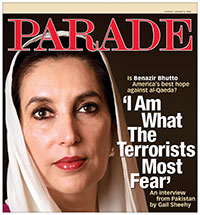 This morning’s Parade Magazine (January 6th, 2008) cover article is on Benazir Bhutto — a refreshingly newsworthy subject for the magazine. After all, Bhutto was assassinated on December 27th, and her death has brought new concerns about the future of Pakistan and the region.
However, the cover headline asks an unsettling question: “Is Benazir Bhutto America’s best hope against al-Qaeda?”
Gosh, I hope not. Considering she died ten days ago.
The article by Gail Sheehy was written before the assassination. That’s okay. But the printed version makes no clarification whatsoever about what’s happened in the meantime: in Parade-land, Bhutto is still alive, racing towards the election. She’s our best hope!
Obviously, Parade is printed in advance. From the website: “The assassination of Pakistan’s Benazir Bhutto on Dec. 27 occurred after PARADE’s Jan. 6 issue went to press.”
But does Parade really need to be printed ten days in advance? Did the editors spend the last week and a half sitting on their hands, hoping their average reader would be so clueless to world events so as not to notice that the subject of their lead article was gunned down for the world to see? (Sadly, the editors’ gamble may be reasonable.)
The web enables print media to amend and expand their reporting, which Parade did to some degree. From the site: “After her assassination, PARADE immediately posted the entire interview online,” which is a great start, but then, “and Sheehy appeared on network and cable TV news shows to discuss her face-to-face conversations with Bhutto.”
So you put your journalist on television to talk about the interview, but then declined to frame the article in context for your publication?
I’ve worked in media enough to know that nothing is impossible. They could have fixed the cover. They could have added an introductory paragraph pointing readers to the web for more information. And failing that, they could have wrapped the issue with an explanatory note.
But they would have only done that if they were an actual news publication, rather than a crappy info-tainment tabloid pretending to be one.
My beef about their “long lead time” excuse is that the insert is included in daily newspapers across the country, which creates the expectation that it’s at least somewhat timely. Which it’s not.
And so the onus really falls on newspapers like the Los Angeles Times, which need to be proactive about how they’re going handle such errors. After all, the printed copy of Parade says “Los Angeles Times” at the top, in the newspaper’s logotype. In simple fact, the January 6th, 2008 edition of the Los Angeles Times says Benazir Bhutto is still alive. That’s embarrassing.
Update: I’m delighted to find I’m not the only one aggravated.
Back to the picket factory
Saturday, January 5th, 2008After a nice vacation, it’s back to the picket lines on Monday. I’ll be returning to my home studio, Paramount, working the 5:45 a.m. to 9 a.m. shift. That’s fifteen minutes later than it used to be, so you can’t say that the WGA isn’t mixing it up for the New Year.
For reasons too nascent to blog about, I’ll probably end up working more van-loading or phone bank shifts this coming month. So if you’re coming out to visit, definitely check the blog the night before.
On horseshit, and the New York Times
Monday, December 31st, 2007I’m quoted in an article in today’s New York Times about how the strike has affected relationships between writers and executives. More accurately, the blog is quoted; I didn’t speak to the writer.
“In November, John August, the writer of movies like “Charlie’s Angeles” [sic] and “Corpse Bride,” spied Peter Roth, president of Warner Brothers Television, at Osteria Mozza, a Los Angeles restaurant. “When you see someone you kind of know at a restaurant, it’s always a process to figure out whether or not to say hi,” Mr. August wrote on his blog. “But the strike makes that decision process much more complicated.”
Instead of confronting the studio executive, Mr. August returned home and wrote a vulgar blog entry about what he would have liked to say. One part of it that is printable here said: “Everyone knows the C.E.O.’s are talking out of two sides of their mouths.”
Really? What vulgar thing did I write about Peter Roth? I only remembered an insider reference to how Peter Roth tends to hug people. (He does.)
Let’s look back at the original post from November 15th, and my imagined conversation:
- ME
- Hey Peter. John August.
- PETER ROTH
- John. John August! How are you? This strike, huh? Crazy. I can’t wait for this to be over.
- ME
- Then tell your side to come back to the table with an internet residual plan that isn’t horseshit, and you could be shooting pilots by February. Because I’ve been on the picket line for seven days, and every writer wants to come back to work. But not a single one of them would take that shitty deal. Because everyone knows what’s at stake, and everyone knows the CEO’s are talking out of two sides of their mouths.
Obviously, the word in question is “horseshit.” I immediately did a web search of the New York Times website to find all the other instances in which they used “horseshit” in a quote, and found exactly zero results. They really don’t print the word.1
Honestly, I find it charming that they deem certain common words too coarse for their readers. They also insist on using polite forms such as “Mr. Smith,” even when it creates more confusion. It’s their newspaper, and they’re entitled to their quirks.2
So it seems that the writer of the article was following Times policy in not printing the full, horseshit-inclusive quote. I can’t object to that.
But what I can object to is labeling my original statement vulgar. That’s a pretty condemnatory remark to slip into a light news piece, considering the word in question is barely PG-13. “Horseshit” may not be an approved word for the New York Times, but it’s a stretch to claim that the mythical New York Times reader would consider it vulgar. It’s basic cable at this point.
Worse, by omitting what I actually said, the article creates the implication I said something much worse. Something — gulp! — unprintably awful. Which I didn’t. I said that the AMPTP’s offer on the table was horseshit. Which it was.
- They will use “shit” on occasion, such as when the president was quoted as saying, “What they need to do is get Syria to get Hezbollah to stop doing this shit, and it’s over.” ↩
- I’m also a fan of Technology Review’s predilection for the diaeresis, such as coöperate. ↩
Characters who are not yet important
Saturday, December 22nd, 2007 If the first time a character appears in a screenplay, it is in a scene in which he does nothing — he is just a peripheral presence — should he be introduced at that point?
The specific scene I’m writing is a funeral. There are four characters in that scene that we haven’t met yet. In that scene they don’t really do or say anything notable; they are peripheral mourners. They will all become significant characters later on in the screenplay. Does convention dictate that I introduce them to the reader at that point? (When we meet them later on, we’re supposed to recognize them as having been present at the funeral.)
– Ed
New York City
Yes. If a character needs to be in a scene, you need to put him there. If you don’t, there’s every possibility he’ll get dropped out of the schedule when it comes time to shoot that scene. Screenplays are literary works, but they’re also instructions. Recipes of a sort. While it might be tempting to leave something out — “Of course they’ll remember that Balthazar is at the funeral!” — assumptions like this invite mistakes.
Ideally, the very first time we meet a character, his introduction should be meaningful, giving us some reason to remember who he is and keep us curious what he’ll do. But there are valid reasons why this might not happen, and crowded moments like funerals and weddings are one example.
So if you need to include a character in this way, remember that you’ll need to make your proper introduction later. For example, in the funeral scene, you might simply write…
- Among the mourners are JOHN BALTHAZAR (50) and his wispy daughter FIONA (21), who hover near the edge of the crowd. Closer to the action are two imposing men in sunglasses — ELAN and MAX, both 25. We’ll meet them all later, but for now, they’re merely paying their respects.
Later in the script, when we really need to meet one of them, we can do the proper setup…
- Glenn sits across the table from John Balthazar, who we saw briefly at the funeral. With broad shoulders and a piercing gaze, he has the look of a Viking forced to wear to a suit. He keeps his knife and fork clutched like weapons throughout the meal.
You don’t capitalize his name in this second introduction. Since it will be the first time he’s spoken, the dialogue should be enough to help the reader notice that someone new has joined the story.
For Your Consideration
Friday, December 21st, 2007One of the perks of being in the WGA is that you get sent scripts and screener DVDs for many of the year’s best movies. Just this week, I got Juno and The Savages. My Christmas holiday to-watch list keeps getting longer.
WGA members are sent these scripts and screeners in the hopes that they’ll be nominated for the awards, obviously.1 But it’s not always clear why some movies are “For Your Consideration,” while others aren’t.
The answer has less to do with critics than calendars; the decision is made months before the movie is released. It’s made by studio marketing departments, who are looking at dates, cast and comparable films to figure out whether it’s worth the money and time it takes to mount a serious FYC campaign.
Sony decided Big Fish was an awards contender, so they bought the ads and publicity to support it. We screened for the National Board of Review and all of the other tastemakers. In the end, we got a handful of nominations. I got Best Adapted Screenplay nominations from the Broadcast Film Critics and the BAFTA’s.
But a few years earlier, the studio didn’t try to get anything for Go. We’d debuted at Sundance, and had gotten terrific reviews, but since we hit theaters in February of that year, there were other movies for the studio to promote by the time awards season came. Doug Liman, Sarah Polley and I would have been longshots — but our names could certainly have been placed in the mix. But for Sony, a couple of award nominations would have meant very little for an R-rated teen comedy already at Blockbuster.
With the summer release of The Nines, I knew there was little chance we’d be remembered come awards time — and zero money for ads, mailers and screenings to refresh people’s memories.2 I would have loved some actorly appreciation for Ryan and Melissa, who are consistently singled out in reviews for being terrific in multiple roles, even by critics who didn’t like the movie.
But I’ve tried not to be frustrated when looking at the 14th full page For Your Consideration ad in Variety for a “worthy” movie I know is worthless. The awards campaign was always part of these Very Important Movies’ marketing. It wasn’t for ours. Our target audience was the intersection of sci-fi geeks and Sundance aficionados, who we’ll reach better when the movie comes out on DVD
We didn’t send out the script of The Nines, although it’s been available for download for months. With a bit of stomping and fuss, I probably could have gotten the distributor to mail it to at least WGA members. And I kind of regret not pushing for it, because I have a hunch that the small subset of members who actually read the scripts they’re sent3 are the ones inclined to log in and do the new online nominations for the WGA Awards.
So if you’re a WGA member who falls into that category, let me invite you to read it and nominate it if it seems like one of the five best contenders for Original Screenplay this year. (We’re number #109 on the ballot. The deadline is January 8th at noon.)
Did that feel uncomfortable? Because it was. It’s so much nicer to sit behind a glossy trade ad than ask a reader for his or her vote. But I just did.
I’ll be heading out for a Christmas holiday, but I’ll be checking in occasionally. If I don’t see you, have a good one.
- Specifically the WGA Awards, which I have a hunch will not be picketed, unlike some others. ↩
- It didn’t matter that we’d only come out in New York, LA and Austin. Most of the awards-givers are conveniently housed there. ↩
- My great frustration is that awards for Best Screenplay are given without any direct exposure to the screenplay. You’re watching the finished movie and guessing which ones were well-written. The more honest award would be given to the director for Not Fucking Up What Was Probably a Good Script. ↩
Strike, days 42 and 43
Tuesday, December 18th, 2007Yesterday was the last official day of picketing before the new year. I was happy to see a large contingent turning out at 5:30 a.m. for my home gate at Paramount. Blog reader Andrew brought along his girlfriend Olivia. Since she’s not even a future WGA member, I felt an obligation to promise her that if the UCLA psych-bio majors ever go on strike, I’ll carry a sign at her picket.
Paul Weitz came as well, which gave us an opportunity to talk about the experience of being in the audience at a Sarah Silverman show. Mostly, it’s really funny. And then a moment comes when you realize the boundary between hilarious and offensive has been breached, and you find yourself replaying the last few jokes to figure out exactly when it happened.
I missed the general membership meeting last night in Santa Monica, because (a) we had guests over for dinner, and (b) open microphones make me squirm. I was in bed by nine.
This afternoon, I’m having the Disney Feature Fellows over for a chat about craft and career. It’s a cold, drizzly, sleepy day, which seems perfect for quasi-academic conversation.
In a previous comment thread, reader Paul Ramos (a friend from Boulder) asks…
Is it totally outside of the realm of possibility that the WGA can form its own production house that offers the terms that writers are looking for? Or is it just completely financially un-doable? Why must writers deal with production houses that don’t want to play ball? I realize that these questions probably seem rather naive. But wouldn’t distributors of media still be interested in a movie shot by the WGA vs. by Paramount or some other large production house?
Not naive at all. While the WGA itself can’t be in the movie or television production business (it’s a union which represents writers, rather than employing them), there’s nothing preventing writers from finding alternate sources of funding and setting up their own productions.
And, in fact, that’s happening as we speak. There are venture capitalists who recognize this as a unique opportunity: you have giant pool of unemployed content creators, and a hungry distribution system (the internet). Depending on the nature of those deals, they would probably need WGA vetting. But there’s a history of alternative deals being reached.
At the Indie Gate last Thursday, I heard it put thusly:
After the first time negotiations fell apart, the message was, “Come back, baby. We can work this out.”
After this last blow-out, the message is slowly becoming, “Maybe we should see other people.”
Look, the strike will end eventually. We’ll go back to working with and for the studios, writing TV series and summer blockbusters that make money for everyone. But we’re at a strange point in time. Certain ideas, certain properties, may not need giant corporations behind them. If you created the next South Park, or the next It’s Always Sunny in Philadelphia, you as the creator might find it more profitable to deliver it through the internet, where the playing fields are much more level.
That’s one irony of the strike: the key issue of internet distribution may become more viable because of the strike itself.
LA Times Dust-Up
Sunday, December 16th, 2007The point-counterpoint debate going on over at LA Times.com makes for good reading, with Craig Mazin and Matt Edelman discussing the strike.


