Archive for the ‘Screenwriting’ Category

Final Draft update adds highlighting, quicker PDFs

Monday, October 26th, 2009

Final Draft 8.01 adds one thing I really wanted — a highlighter right in the toolbar.

And for those frustrated by FD8 forcing you to create .pdfs through the Print dialog box, you can now make a .pdf right from the file menu. (Weirdly, the vestigial disabled Email menu item is still there.)

I’ve tested the new version for all of three minutes, so I certainly can’t vouch for its stability. And I haven’t tested its Script Compare ability at all, but it could be a handy way of created starred changes when you forget to turn revisions on.

Digg Facebook Reddit SphereIt StumbleUpon Twitter

Netflix streaming to PlayStation 3

Monday, October 26th, 2009

Sony and Netflix announced today that starting next month, you’ll be able to use Netflix’s “watch instantly” feature through the PlayStation 3. After spending its life banished to the garage office, this change might finally get my PS3 a place in the main house.

Netflix streaming is already available on XBox (Gold), Roku, and a few other devices. I’ve read interviews with Netflix CEO Reed Hastings talking about his goal of making it ubiquitous, and this seems like part of that plan.

The Nines has been streaming for a few months now through Netflix. While I don’t get viewer numbers, a scan of Twitter shows that a lot of people are watching it this way. It’s legal, legit, and actually lets filmmakers get paid.

Digg Facebook Reddit SphereIt StumbleUpon Twitter

Money 101 for screenwriters

Thursday, December 18th, 2008

Most of the questions I answer on this site are from readers who hope to become professional screenwriters. A small percentage of these readers will succeed, and suddenly face a new category of questions about What Happens Next. Having watched former assistants and other young writers cross the line into professional work, I’ve noticed that one of the biggest mysteries is money.

I want to offer a brief financial education for the newly-employed screenwriter. For most of you, this won’t apply — yet, if ever. But for others, this may be worth a bookmark, because there are some specific, unusual things you need to know. Screenwriting is a strange profession, and handling the money it generates is more complicated than you’d think.

1. Don’t quit your day job — until you have to.

Before writing this post, I asked a dozen working writers for their recommendations, and this was by far the most-often made point.

The natural instinct is to immediately quit your crappy day job once you’re hired to write something (or sell a spec). After all, isn’t that the dream? Isn’t this why you came to Hollywood? Every waiter and barrista in Los Angeles considers himself a screenwriter, so quitting your day job is an important way to distinguish yourself as a True Screenwriter, the kind who gets paid actual money to push words around in 12-pt Courier.

But don’t. Don’t quit your job right away.

Even if you sell a spec for $200K, it will be months before you see a cent. The studio will sit on your contract as lawyers exchange pencil notes about things you can’t believe aren’t boilerplate. When I was hired for my first job,1 it took almost four months before I got a paycheck. I was living off of money from a novelization, but when that ran out, I had to ask my mom for help paying rent.

Nearly every screenwriter I speak with has a similar story — you’re never as broke as when you first start making money.

Beyond the initial delay in getting paid, keep in mind that there’s no guarantee you’ll have a second writing job. I haven’t seen numbers, but my hunch is that a substantial portion of new WGA members aren’t getting paid as screenwriters two years later. A career is not one sale. As one writer friend says, “I always think of myself as six months away from teaching community college.”

If all goes well, the needs of your career will eventually force you to give up your day job. You’ll have meetings at 11 a.m. on a Wednesday, and no more excuses to offer your boss. Or you’ll be hired on a TV show, which is at least two full-time jobs. So don’t panic when it comes time to quit. Just try to leave on good terms, with back-of-mind awareness that at some point you may need to get a normal job again.

Here’s how the transition happened for my former assistants:

  • Rawson finally quit working for me because the movie he was directing (Dodgeball) was in preproduction. He went from being an assistant to having an assistant in less than a week.

  • Dana had a movie greenlit and another script under a tight deadline.

  • Chad met with Aaron Sorkin on a Tuesday morning — and got hired in the room. He had to start working on Studio 60 that afternoon.

Each of them left, but only after the needs of their writing career made it impossible not to. In the meantime, they had regular hours and health insurance. That last part is especially worthy of attention, because it may take months to get WGA health insurance started after making a sale.

2. It’s less money than you think.

We’re used to getting paychecks that have all of the taxes and expenses taken out. Maybe you’re bringing home $850 per week. The math is relatively straightforward: you know how much you need for rent, food, utilities and whatnot. And next week, you’ll get another check.

Screenwriting is nothing like that. You get paid in chunks, from which you have to pay taxes and percentages to all the people working for you. The money shrinks at an alarming rate. Worse, you have limited ability to predict when you’ll get paid again.

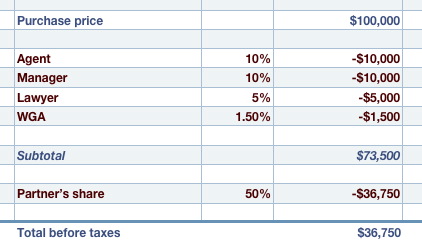
As an example, let’s say you and your writing partner sell a spec script to a studio for $100,000. That seems like pretty good money. But how much of it do you get to keep? Let’s run the numbers.
100k grid

Out of all that money, you have less than $37K, and that’s before you’ve paid a penny of taxes. So don’t buy your fractional Net Jet just yet.

Some points while we’re here:

  • Not every writer has a manager. I never did. Many beginning writers find managers helpful in making contacts and working on pitches. Your mileage may vary.

  • While most managers get 10%, that’s not fixed by law the way it is with agents.

  • You can also pay attorneys by the hour — but they’re well worth the 5%.

  • You generally don’t write a check for your agent and attorney — that money is deducted by the agency when they collect from the studio for you.

  • The WGA sends you a form every quarter on which you list what you’ve been paid by signatory companies. It’s your responsibility to pay dues.

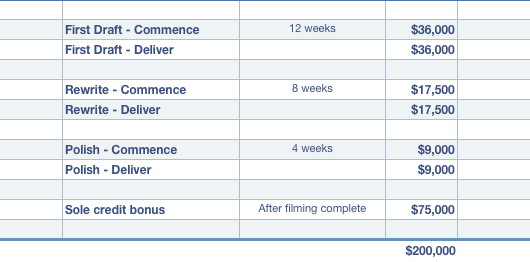
Flipping through Variety, you might think that all screenwriters are rich. For instance, you might read that Sally Romcom sold a pitch for “low six figures.” That’s slanguage for $100 to $250K — still a lot of money. But if you actually looked at her deal, you’d see that the money is structured in a way that she’s unlikely to get it all at once, or even in the same year.
deal steps

Sally is getting paid in three steps: first draft, rewrite and polish. For each step, she is being paid half at commencement, and half when she delivers. Each step has a time frame, ranging from 12 weeks for the first draft to four weeks for the polish. There is generally a four-week guaranteed reading period between each step, which means that the fastest she could expect to be paid for these three steps is 32 weeks (12 + 4 + 8 + 4 + 4).

She’ll get $125K for these three steps. The $75K sole credit bonus only happens if (a) the movie gets made, and (b) she’s the only credited writer on it. 2

In order to pay her bills, Sally needs to be able to predict when she’s going to be getting more money. For years, I kept a spreadsheet tracking projects and expenses across upcoming months, to make sure I’d have enough cash to pay rent six months down the road.

3. WGA membership happens automatically

One day, you’re an aspiring screenwriter who hopes to join the Writers Guild. The next, you’re a working screenwriter who must join the guild by law.

The first time you sell a script to (or are hired to write by) a signatory company,3 you need to join the Guild. Odds are, the guild will contact you as soon as paperwork crosses the right desk, but you can also jumpstart the process by calling the Los Angeles office.

You’ll have to pay a fee of $2,500 to join. 4 Ask nicely, and they’ll let you spread out the payments.

The most immediate benefit to joining the guild is the health insurance. The plans and benefits are confusing but extensive, with trade-offs for Preferred Providers versus HMOs. It’s worth spending a few hours getting it set up correctly. Once you’re in the plan, you’ll need to keep working in order to maintain eligibility.

4. Splurge on one thing

Once you start making money, there’s a natural instinct to upgrade every aspect of your lifestyle, which has probably stalled out in a post-college, heavy-Ikea phase. Don’t. You’ll burn through your money and wonder what you spent it on. Instead, buy one thing you really want and can afford. Make that your reward.

For me, it was getting a dog. I’d wanted one since I was 10, and I was determined to move to an apartment that allowed dogs. I found a duplex off Melrose and got my pug. Twelve years later, he’s still sleeping at my feet. He’s a good dog and a good reminder of how my career started.

Your dog equivalent may be a car, a painting, or a 30-inch monitor. Buy it and enjoy it.

But don’t feel any pressure to act rich. I drive a six-year old Toyota. We buy store brands and clip coupons. We fly coach.5

Over time, you will probably start spending more on housing, clothing, travel and food as your standards rise. That’s okay. But spend your mad money on things on those few things that actually make you happy.

5. Don’t rush to pay off your student loans

Everyone wants to be debt-free, but classic federal student loans are some of the cheapest money you’re ever going to find. Until you feel confident that you’ll have enough money to last you a solid year, keep paying your normal amount.

Instead, pay off your credit cards and private student loans, which tend to have much higher interest rates.

6. Sock it away

Whether you’ve made a bunch of money at once in a spec sale, or carefully grown a nest egg through steady assignments, you’ll want to put your money in two virtual boxes. In the first, stash enough to live on for six months (including taxes). In the second box, put all the rest of the money you make — and pretend it doesn’t exist.

I’m not qualified to talk about investments, pensions or retirement, but I feel absolutely certain giving you this financial advice: save your money. Get financial advice about about smart places to put it, and then leave it alone. Except for rare occasions — buying a house, for example — you should never need to touch it. Your living expenses should be more than covered by new money coming in the door.

7. At some point, you’ll incorporate

When a studio hires me, they actually hire my loan-out corporation, which provides both tax advantages and liability benefits. I didn’t become a corporation until after Go, at which point my agent and attorney told me it was time. 6 It’s a lot of paperwork to set up — your attorney will do most of it — and a fair amount of responsibility, with quarterly taxes and other filings.

Like heart surgery, it’s smart to ask a lot of questions, but you ultimately want it handled by professionals who do it every day.

Before becoming a corporation, I was managing my money easily with Quicken and Excel. The added complexity of the corporation led me to hire a business manager and accountant. The best resource for finding a good business manager is other writers. You want someone responsible, reachable and thorough. Keep in mind that a business manager is not an investment guy. A business manager is writing checks to keep the lights on. The only financial advice you’ll be getting from your business manager is to spend less money, which is always worth hearing.


  1. I adapted the kids book How to Eat Fried Worms for Imagine.
  2. The shorthand for Sally’s deal would be “125 against 200.” The first number is what she’s guaranteed to make, while the second represents what she’ll get if the movie is made.
  3. There are a few indie companies which are not under the WGA deal, but every major studio is.
  4. WGA East costs $1,500 to join. No, I don’t know why it’s cheaper.
  5. Though we’re pretty canny with upgrades. Get a credit card that pays you either frequent flier miles or hotel points, and use that for everything.
  6. I’ve often heard $200K/year as being the threshold at which point incorporation makes sense, but it may be higher or lower depending on circumstances.

Go on Hulu

Monday, December 15th, 2008

Online video service Hulu is now featuring my first movie, Go. If you haven’t seen it — and you live in U.S., and you’re over 17 — it’s worth a look. It even has a great, minimalist URL:

http://www.hulu.com/go

I really doubted Hulu when it was first announced, because everything the studios touch tends to be needlessly complicated and crappy. But Hulu works great for catching up on old TV shows, and now movies. The advertising isn’t terribly intrusive, either.

Will I get residuals? We’ll see. But considering Go is easily available in hundreds of illegal sites online, I’m just happy to find it in a clean, well-lighted place with 480p resolution.

Six week bug

Thursday, December 11th, 2008

I’m finally over the annoying illness that’s kept me on a reduced schedule these past few weeks. I’m calling it bronchitis, though my doctor never used that term, and it’s possible it was something else entirely. In general I’m not a person who gets sick for more than a day or two, so it was frustrating to feel lousy this long.

It wasn’t until conversations at a cocktail on Saturday that I realized a huge chunk of my writer/actor/lawyer friends have or had the same thing, with symptoms roughly as follows:

  • Gurgling when you lie down to sleep.

  • Mild fever, or chills or headache — but not enough to make you feel sick-sick.

  • The kind of cough which, if you heard it come from an actor in a period drama, would telegraph the character’s impending death by consumption.

The insidious thing about this bug is that I generally didn’t felt bad enough to go the doctor. I’d skip the gym or go to bed early, but truly thought I’d be able to ride it out. I finally went in to get some drugs, and was better in a week.

In conversations with everyone who’s had it, the treatment always seems to comprise three things: an antibiotic, a decongestant and cough syrup. The brands change, but that’s always the cocktail. Of the three, the behind-the-counter decongestant (Claritin-D) required the most paranoia-inducing paperwork.1 But the prescription cough syrup was also unsettling, because it worked so well and felt so good. I was careful to limit my doses.

Just when I thought I’d beaten the bug, it roared back to life like Glenn Close leaping from the bathtub in Fatal Attraction. I’m pretty sure now that last jolt was just me kicking the cough syrup, despite my moderation.

Still, it feels good to feel like me again. Though I now have less excuse for endless Fallout 3 sessions.

  1. It contains pseudoephedrine, with is used to make meth, so the government tracks every sale.

USC at Sundance/Slamdance

Wednesday, December 10th, 2008

A reminder for USC alums with movies playing at this year’s festivals: make sure the school knows so they can invite you to events: alumni@cinema.usc.edu.

Also, feel free to hype it in this thread.

Rewriting the rewriter

Wednesday, December 10th, 2008

questionmarkHow often do original screenwriters, who’ve been rewritten by other fellows, get hired back onto their original scripts? Does it matter if the script is revving up to go into production? I’ve heard of a few other guys like Josh Friedman (Chain Reaction) and Michael Arndt (Little Miss Sunshine) hopping back on, but are they the exception or the rule?

– Lewis

It’s not uncommon. I was on and off both Charlie’s Angels movies several times, and I can think of at least half a dozen other cases where the original writers came back in before (or during) production.

In order to understand why the original writers are sometimes rehired, you have to understand why they leave projects. Sometimes, it’s simple availability: at a crucial moment during development of the first Charlie’s Angels, I was shooting a series in Toronto, so someone else got the gig (a long string of someone elses, as it turned out). In other cases, a new element (director, producer, star) wants to take the script in a new direction, which generally means a new writer — often someone they’ve worked with before.

You’re not always fired, and it’s not always acrimonious. That’s important to understand. The screenwriter wants the movie made, and wants to maintain relationships with the filmmakers and the studio. So it behooves everyone to make sure the original writer is at least peripherally involved, even if he’s no longer the active writer on the project.

The original writer might get asked back for several reasons. The simplest is cost: she may be willing to do a lot of piece work essentially for free because it’s her movie. But more often there is something about the original writer’s voice or vision that remains important despite subsequent revisions, and the producers (or director, or stars) recognize this. So she comes back in to make the new stuff feel like her stuff, and let it read like one movie rather than a patchwork.

On the radio

Friday, December 5th, 2008

questionmarkI’m working on a script that includes a few scenes where characters talk on police radios, or on megaphones.

So my question is this:

How do you write that? I suppose it’s just a matter of picking a format and sticking to it throughout the script, but I thought I would fire this question across your desk in case you’ve already standardized how it might look. Currently I’m toying with something that might go along the lines of:

INT. POLICE CRUISER - NIGHT

The radio crackles with three call tones. Perry grabs the receiver.

PERRY

Go for Perry.

DISPATCH (ON RADIO)

(filtered)

Your mother’s calling 9-1-1 again, Perr. Says you’re grounded.

PERRY

Tell her I’m working. I’ve got a job, and I’m working. I’m already on patrol, Walter...and I’m 30.

DISPATCH (ON RADIO)

(filtered)

She’s threatening the Playstation.

PERRY

Tell her I’ll be right there.

He tosses the handset, floors it, and cranks up the siren and lights.

The other format I’m trying to crack is when someone picks up a megaphone to address a crowd of people. So far I have something like:

EXT. PERRY’S HOUSE - NIGHT

The squad car screeches up in front of the house. Perry’s mom opens the top floor window and extends the Playstation over the ledge.

Perry jumps out, holds up a megaphone.

PERRY

(filtered)

Don’t do it, mom. Go back inside, and keep the Playstation where I can see it.

PERRY’S MOM

You’re a rotten kid, Perry. Rotten to the core.

PERRY

(filtered)

I mean it. I’ll use force if I have to.

I’m not sure if you need the word “filtered” in parentheticals in both examples, and if I do, should I put it on each line, or just the first? With the radio lines, I’ve put “ON RADIO” next to the name, and on each line. Do I need to include it on more than one, or is the first sufficient?

– Scott Benton
Los Angeles

In both cases, I would drop the “(filtered)” tag on the second line of dialogue. We get it, and reminding us that it’s filtered is just getting in the way of the jokes.

While we’re on the topic, I’m a fan of how you used DISPATCH (ON RADIO) in the first example. I find myself doing that a lot in situations where the speaker is not physically present in the scene. In some cases, it indicates a character we’ll never really meet (perhaps your Dispatcher), or a character we do meet who happens to be on a speakerphone or similarly off-screen.

Putting the parenthetical as part of the character name helps reinforce that the person won’t be seen. That’s clarity for the reader and for 1st ADs when it comes time to write the shooting schedule.

How long should it take to write a script?

Monday, December 1st, 2008

Answering a recent question, I made the following unqualified assertion:

Six weeks is a long time. I say this not to panic you, but to make sure you understand that employable screenwriters need to be able to produce on demand.

In the comment thread that followed — and subsequent emails — many readers wondered exactly how long was too long, and what was a reasonable timeframe in which a screenwriter should be expected to deliver a script. So let’s try to answer those questions.

When a screenwriter is hired to write a project (like Shazam!, or Big Fish), the contract generally allows for a 12-week writing period for the first draft. Subsequent rewrites and polishes are given shorter time period, anywhere from eight weeks to two weeks.

In practice, I’ve never seen these contractual writing periods enforced. 1 Rather, a few weeks into the process, a producer or studio executive calls the screenwriter and the following conversation takes place:

PRODUCER

So, how’s the writing going?

WRITER

Good. Good.

PRODUCER

I know it’s early, but do you gotta sense of when you’re going to be finished?

WRITER

Umm....

PRODUCER

Just ballpark, like, end of January? Start of February?

WRITER

Yeah. Absolutely.

PRODUCER

Great. Great. Because I know the studio’s really excited to see it, and it would be great to get it in around then.

WRITER

Shouldn’t be a problem.

PRODUCER

I’ll just check in with you in a coupla weeks, make sure everything’s going okay.

I’ve encountered some version of this conversation on every project I’ve written. Follow-up phone calls try to narrow the time frame down even more, with the goal of getting you to deliver the script on a Thursday or Friday so everyone can read it over the weekend.

I’m hesitant to give a firm number for how many weeks it should take to write a script. Every project is different. Big Fish took me the better part of four months, while Charlie and the Chocolate Factory was three weeks. But part of the reason Charlie was only three weeks was because that’s all the time there was. There was already a release date, and sets were being built.

And that points to the better question to ask: How quickly should a professional screenwriter be able to turn around a script, given some urgency? In my experience, the most successful screenwriters are the ones who are able to accurately estimate how much time they’ll need. That’s part of the craft, just like a cabinetmaker promising a delivery date. For my work on Iron Man, I told them exactly how many days it would take to address certain issues, and delivered pages every night.

For feature films, I’d be reluctant to hire a writer who couldn’t deliver a script in eight weeks. For television, writers sometimes have less than a week to get a one-hour episode written. You’d like to give every writer as much time as she needs, but in my experience, the deadline is often the main force getting the script finished.

  1. In a few cases where a movie was rushing to production, my contracts have had special language like “Time is of the essence” or similar, which I suspect is a giant flashing arrow to indicate that the studio really would consider withholding payment if delivery were late.

Trifecta

Friday, November 28th, 2008

The combination of family travel, lingering illness and Fallout 3 has kept me away from the blog this week, but I should be back to a normal schedule beginning Sunday.

There’s actual news, including my next writing project and an update (post-mortem?) on Shazam!. Plus, I really want to write something about this misguided memo from Thomas Kinkade reprinted in Vanity Fair. It’s a good cautionary tale.

(Update: Fixed spelling of Kinkade’s name. Thanks Matt Redd.)