Archive for the ‘Screenwriting’ Category

France, finished

Wednesday, November 19th, 2008

The sweet, dark gravity of jetlag has subsided, so it’s time I put up a link to the rest of my pictures from France. They’re not all labeled at the moment, but proper titles are coming.

photo gridFor those who don’t recall, I joined a group of nine American screenwriters on a program organized by Film France to explore Paris and Marseilles. The trip was exhausting in just the right ways, with too many people to meet and too much to see. Over eight days, I rode in several vans, a helicopter, a high-speed train, a very slow-speed train, and far more boats than I would have imagined. I even took a Vélib bike for a spin around Paris.

The purpose of the trip was to inspire American screenwriters to write more movies set in — and ideally, shot in — France. Going in, I thought of it like a location scout: a bunch of interesting backdrops, including things a tourist wouldn’t get to see. But as we got more into it, I found myself more drawn to people than places. I would ask a shipping yard exec about daycare, and an heiresses about divorce.

Of our group, I spoke the second-best French (or more precisely, eighth-worst), so I occasionally found myself shoved at the growing pool of journalists who accompanied us. And while my comprehension was surprisingly good, I found no quantum of eloquence when trying to answer questions in French. I sounded like a drunken third-grader. So I learned to nod thoughtfully, then plow ahead in English unabashed.

The trip was full of strange moments that I’d love to string together in a Sedaris-like monologue. The most meta-cinematic was when we found ourselves on a private island owned by the Ricard foundation. A tram tour took us past experimental lagoons, an old Nazi watchtower and the grave of founder Paul Ricard. It was already feeling a little Lost-ish when we got to the Institut, where we watched a self-produced film which could have come directly from the Dharma Initiative.

There was even a scale model of the island:

bubble island

Later, we had a lunch in which every course featured truffles. That was on the other Ricard island.

On our last day, we toured Marseilles’ port in a pilot’s boat, brushing up against giant tankers. It provided good reference for my latest obsession, African piracy. Somehow, I don’t think the Somalian film industry will be getting a program together for us to visit.

Bailing on an idea

Friday, November 14th, 2008

questionmarkI recently got representation, and my agents fell in love with my latest spec idea. Cut to nearly six weeks later and I still haven’t been able to hash it out completely. How do you know when to keep going at an idea in an attempt to crack it and or when to call it a day and realize the idea is not as good as you first thought it was?

What do I tell my agents if I can’t crack it?

– Stef

Your agents probably got excited by the idea because they think they can sell it — and you, as the writer.

Six weeks is a long time. I say this not to panic you, but to make sure you understand that employable screenwriters need to be able to produce on demand. You promised them something and didn’t deliver — that makes them nervous. How can they convince producers to hire you when you can’t hand them the script you yourself pitched?

Yes, sometimes seemingly-good ideas collapse upon further scrutiny, and it’s ultimately better to bail. If you truly can’t make your idea work, you need to move quickly on writing something else that is similarly marketable, even if it’s not the same genre. And you need to do it now.

When your agents ask, “What are you working on?” you should be able to answer immediately and passionately. So if it’s not the project you pitched them, make sure it’s something they’re going to be excited to read.

Including an important symbol

Friday, November 14th, 2008

questionmarkI’m writing a film about a cop whose investigation leads him into the occult, and there’s a particular (real) symbol that crops up several times. It’s more than just a Star of David: in fact, it incorporates several familiar symbols, and also some Hebrew words… anyway, it’s complex. I’ve written the scene where someone in the know walks Our Hero through the symbology, but I want to make sure that my readers really know what it looks like.

Is it appropriate to include an illustration or figure of the symbol at the end of the screenplay? I’ve seen some scripts that have pronunciation guides at the back, so how is this any different?

– Sean Wolfson

You can probably get away with it.

My advice: think about it like a book. In the best-selling novel version of your script, would the author have included the drawing? If so, do it. But only once, and only if it’s really that important.

Short questions, short answers

Sunday, July 6th, 2008

questionmarkIn the Big Fish Sequence Outline posted in the Library, you have boxes around certain sequences (i.e. sequences 3,5,8 etc.), but not around others. What do these boxes reference?

– Gerald
Mississippi

The boxes indicate which sections of the movie are Edward’s stories. I wanted to show the balance between real-world stuff and fable.


Why did Edward Bloom leave Ashland?

– Anonymous

Because it’s too small for a man of his ambition. That’s what Edward says to Karl the Giant before they head off on their adventure.


Beginner’s luck? Is that supposed to happen?

– Mark

It’s a fallacy. We expect someone trying something for the first time to fail, so when they succeed, we call it “beginner’s luck” to discount it. But depending on the nature of the task, it’s actually just skill or garden-variety luck.

A person who succeeds early and later fails may likewise try to diminish the first success by declaring it “beginner’s luck.” But it’s almost worth looking at the situation in which they were first successful, and what’s changed. Likely the “beginning” was an arbitrary point decided after the fact, and the subsequent efforts are being scored by different and perhaps unrealistic criteria.

Self-distributing an indie feature

Sunday, July 6th, 2008

Todd Sklar, who I know from his work up at the Sundance Labs, wrote in to agree with a lot of the points I raised in my post-mortem of The Nines. His experience with the indie film he made and self-released is alternately inspiring and exhausting, but worth careful attention for anyone considering making a festival feature.

They basically treated their indie film like an indie band, going gig to gig and selling out of the back of their car. It worked, more or less, but it demanded an amazing amount of chutzpah and commitment, which not all filmmakers are going to be able to muster.


first person tagWhile I was at the labs, I was in the midst of making a low budget feature, which I’ve now completed, and also self-distributed throughout 34 markets.

SklarAlong with some of my cast and crew, I accompanied the film on the road for 3 months in order to help market the film in each city. We basically set the whole thing up like a band would do for a tour, supplementing the screenings with intensive grass-roots marketing and also using social networking sites to create a viral buzz prior to our arrival.

Our entire model was conceived around the concept of using the theatrical release as a tool for the ancillary benefits it can provide: building a fan-base for future projects, acting as a platform and catalyst for DVD and download releases, and providing a ton of press exposure and validation for the film to name a few.

As such, our overall goal for the tour was to break even. We felt that if we could sustain the touring of the film for the entire 3 and half month tour, the real reward would be the opportunities that would develop by maintaining the film’s limited theatrical life for as long as possible, and in as many different places as possible. I compare it a lot to when companies will build a brand, in order to create a name for themselves amongst their target audience, or when a politician will it the road to raise awareness of his campaign.

In the end, we sold a little over 9,600 tickets, as well as 800+ DVDs, despite only having them available at the last 11 screenings.

We split our ticket sales directly with the theatres, and used niche-oriented marketing to keep promotional costs down, and in the end, we grossed around $32,000 theatrically. After factoring in all the expenses, we found ourselves with a profit near $11,000. As a result, we’ll be touring again in the fall & spring, while also bringing a handful of other films with us in an attempt to make this a repeatable and sustainable distribution model.

You can check out more info on the film here; www.boxeldermovie.com. Plus there’s more verbiage on the aforementioned self-distribution stuff if you’re intrigued. We’re creating a postmortem document similar to your blog post in regards to the tour.

Again, excellent post and viewpoint on the matter, and thanks again for all that you do.

I never told Robert Redford to suck it

Thursday, July 3rd, 2008

I want to expand, redirect and challenge some of the discussion on my earlier post about Sundance, The Nines, and the death of independent film.

For starters, many in the P2P world were all too happy to declare victory over, well, logic. (The Nines Director: Forget Sundance, Use P2P Instead). That’s incorrect on a lot of levels.

In the article, I said that leaking a copy online at the right moment would have certainly increased awareness, and might have helped sales of tickets, DVDs and paid downloads. Notice that I really am talking about sales — that antiquated notion where people pay for things. My thesis is that if you make it at least as easy to obtain something legally as illegally, a fair number of potential users are happy to pay for it.

And I said nothing approaching, “Forget Sundance.” I said that Sundance buzz is annoying and meaningless, but that doesn’t mean the festival is irrelevant. Quite the contrary. Film festivals are public events in which thousands of people come together to watch challenging, independent film. The failure of arthouse distribution for indies makes festivals even more essential, because without film festivals, most of these movies would never screen before an audience.

Sundance is the Grauman’s Chinese Theater of festivals — you really do want to premiere there, to reach the biggest number of eyeballs at once. For two weeks each year, the American media pretends to give a shit about non-blockbusters. People stand in line to see documentaries, and Parker Posey is considered a star. It’s Fantasyland. So you trudge up and down the snow-covered streets, visiting all the different outlets and pimping your movie.

But wait. Didn’t I say the buzz is useless?

I think it is, at least as a component of the traditional bought-at-Sundance, released-six-months-later cycle. But if you could shorten that, and get those buzz-worthy movies from Park City in front of audiences worldwide in two weeks, I think you’d find some real success. Studios do this all the time with their quasi-indies, premiering them at a festival as a launch pad. We did it with Go in 1999.

Would it be difficult to go from Sundance to worldwide in two weeks? Absolutely. The lead time on a commercial DVD is still six weeks or more. But pay-per-view, iTunes and Netflix online have a lot more flexibility. All the legal work (clearances and contracts) would be a scramble. But we absolutely could have done it with The Nines.

Where does that leave theatrical?

I don’t know. My hunch is that for indies, the arthouse circuit is best left to special events and filmmaker Q&A’s. The Academy has rules about how long a film has to play in theaters in order to be eligible for awards, so for certain films, that may be a factor. But what readers outside Los Angeles may not realize is that many of the award-contender movies are sent to voters on DVD before they’re playing theaters.

Other small notes:

  • You can disagree with me about whether Once tanked. I loved the movie, and felt it could have and should have made a lot more. Its low budget is ultimately irrelevant, because the real money was spent on marketing.

  • A Sundance award-winner from this year, Ballast, dropped its deal with IFC and will self-distribute. The director gives a lot of good insight about why, and just how low the dollar figures are. If I were in his shoes, I might have done the same thing. With The Nines, we had Ryan Reynolds and Hope Davis, who were big enough names to generate some minimums. Without any stars, it’s tough to shake out more money.

  • Also notable is that Ballast was to be distributed through IFC’s First Take program, which debuts movies simultaneously in theaters and by video-on-demand, much like 2929’s HDNet Films program. It seems like the right idea, so I’m curious whether the business model will work.

  • The Sundance folks are adamant that it’s a festival, not a market. Redford himself has said, “We have to remind people of who we are and what we’re about…[W]hen buyers are coming in and looking at the guide (for commercial product), I don’t care about what’s commercial. I think we should leave that to the mainstream.”

Coming back to one of the key ideas in the original article, I’d stress that the real measure of success for an indie film’s release is how many people saw it. Festivals let people see your movie. So do theatrical, DVD, pay-per-view, TV and yes, piracy. Finding the right combination these elements is the challenge. I don’t think I have the answer, but I can safely say it’s not what we did on The Nines.

Writing unspoken things

Wednesday, July 2nd, 2008

questionmarkIn an effort to be less on-the-nose with my dialog, I sometimes avoid the dialog all together.

My overly dramatic example:

  • TIM
  • It’s up to us to fix this.
  • Sarah’s face: How?
  • TIM
  • We go back to where it all began.
  • I don’t want to make Sarah ask how. I want her face to convey the message. Have you ever put in directions for the actors like this? If so, how do you format it?

    – Matt R

    You can do this. I’ve seen established screenwriters do essentially the same things in their scripts. But the fact that I’ve never felt the need to do it leads me to suggest alternatives to face-writing.

    The first option is the gerundic dot-dot-dot:

  • TIM
  • It’s up to us to fix this.
  • Answering her question before she can ask it…
  • TIM
  • We go back to where it all began.
  • In this case, it reads just as well without the gerund. Some writers do a double-dash:

  • TIM
  • It’s up to us to fix this.
  • Before she can ask —
  • TIM
  • We go back to where it all began.
  • Another choice is to stay in Tim’s dialog block and do it with a parenthetical:

  • TIM
  • It’s up to us to fix this.
  • (off her reaction)
  • We go back to where it all began.
  • And don’t discount the option of just omitting it:

  • TIM
  • It’s up to us to fix this.
  • CUT TO:
  • EXT. BACK WHERE IT ALL BEGAN - DAY
  • Sarah and Tim sweep the field with metal detectors.
  • There’s no right way — but that’s not to say it’s unimportant. These little choices are what form your style, and developing a narrative voice is a crucial part of your career as a writer.

    When we think of a Tarantino movie, we remember his dialogue. But the experience of reading his scripts is different. They’re incredibly spare but specific. Other writers — David Koepp comes to mind — write in dense blocks packed with detail. And the scripts for Lost are known for their profanity. Every writer would handle the same basic scene differently. Figuring out how you would do it is an important part of becoming a screenwriter, so always challenge yourself to find the way that feels best.

    Sundance, The Nines, and the death of independent film

    Monday, June 30th, 2008

    A quote from Mark Gill in the LA Times last week would seem discouraging for independent filmmakers:

    Of the 5,000 films submitted to Sundance each year — generally with budgets under $10 million — maybe 100 of them got a U.S. theatrical release three years ago. And it used to be that 20 of those would make money. Now maybe five do. That’s one-tenth of 1%. Put another way, if you decide to make a movie budgeted under $10 million on your own tomorrow, you have a 99.9% chance of failure.

    There are lots of ways to criticize his logic. For starters, most Sundance movies are way under $10 million. Many are under a million. And he seems to omit a figure for how many indie films are getting a theatrical release now as opposed to three years ago.

    We need to ask, “Failure for whom?” Even a movie that doesn’t earn its budget back will likely make money for its distributors, once you factor in video and TV sales. More crucially, a good indie film generates future work for its stars and filmmakers. So there’s a lot of success to be found in that 99.9% failure.

    All that said, he’s kind of right.

    I’ve held off writing a post-mortem on The Nines, but now that everything is said and done, I should probably say and do it. The short version is this: the movie turned out just the way I wanted. The release of the movie was deeply disappointing.

    Here are the key lessons I learned from the release:

    1. Sundance buzz is annoying and meaningless

    The Nines premiered at Sundance in 2007. We were happy the film got in — we were by no means a lock, despite our cast, our credits, and my involvement with the Sundance screenwriters lab. We got a slot out of competition on a big screen on a good night. We got a sales agent. Things were looking good.

    My first inkling that something was amiss was when our first choice of publicity teams watched the movie and passed on representing us. They didn’t love the movie. The publicity team we ultimately hired did love the movie, and worked their asses off for it. Yet that first “pass” should have clued us into the reality that the movie was polarizing, and that every subsequent step along the way would be determined by our champions and detractors.

    We did Sundance the way you’re supposed to do Sundance, with all the press interviews and trudging up and down snowy streets. We kept running into the same movies doing the same song-and-dance, several of them represented by the team that first passed on us. It was all smiles, but every time I heard festival-goers discussing another movie, I got jealous — unless it was negative, in which case I got a little happier. That’s a natural instinct, I guess. Indiefreude.

    Looking back through the coverage of the festival, The Nines was one of approximately 20 movies1 that got significant buzz — either spontaneous or self-generated — while up on the mountain. The others included:

    1. The Signal
    2. Chapter 27
    3. The Good Night
    4. Joshua
    5. Teeth
    6. The Ten
    7. Waitress
    8. Under the Same Moon (La Misma Luna)
    9. How She Move
    10. Son of Rambow
    11. Once
    12. Nanking
    13. The King of Kong
    14. Grace is Gone
    15. Dedication
    16. Clubland (aka Introducing the Dwights)
    17. My Kid Could Paint That
    18. King of California
    19. In the Shadow of the Moon
    20. Hounddog

    All of these except Hounddog (the “Dakota Fanning Rape Movie”) sold, either while at Sundance or shortly thereafter.2 Let’s call these the Graduating Class of 2007.

    I’d put The Nines in the middle of the buzz pack. It was hard to get a ticket, and they kept adding additional screenings. But after the debut, it was clear we weren’t going to be in a giant bidding situation. Other movies were selling quickly, and new titles kept debuting.

    Eighteen months later, it’s fascinating to see how little the festival buzz mattered. Prices for these movies — a key component of buzz, as in, “Did you hear how much it sold for?” — were all over the board, from the low six-figures to $7 million for Son of Rambow.

    But it made no difference. They all pretty much tanked.

    Waitress sold quickly, was released quickly, and made the most by far at the box office ($19M).3 Second place was Under the Same Moon ($12.5M), followed by Once ($9M) and How She Move ($7M). Son of Rambow will likely end up in fifth. It’s currently in release, and made $8M overseas.

    In terms of box office, none of these are hits in the way Little Miss Sunshine was. But you’d be happy being any of them, because beyond those five, the other movies on the list fell off a cliff. None of them made a million. In fact, most didn’t make it over $100,000. The Nines didn’t, despite opening well.

    But at least we opened. At least we sold. For our year, 3,287 feature films were submitted to Sundance, of which 122 played. Roughly 20 played in theaters. 4

    The other hundred films played other festivals, and ultimately hoped for a DVD deal. And maybe that’s not all bad. Because you know what?

    2. Theatrical release is kinda bullshit.

    Even while I was making The Nines, I knew that the vast majority of viewers would ultimately see it on the small screen. In that spirit, we worked to make the shiny disc version extra-rewarding, with commentaries and special features planned from day one.

    But at the same time, we were anticipating theatrical. A lot of effort went in to making the 35mm prints — eight prints in all. We would have conference calls to discuss dates and markets and theaters, with special screenings for opening night and whatnot.

    It was a fool’s errand.

    It didn’t feel like it at the time, but the theatrical release was really a token, contractually-obligated gesture. We were getting our hand stamped before the DVD.

    It was billed as a platform release, opening in just a few key markets before going wider. But from the distributor’s perspective, there was no reason to even consider expanding beyond New York, Los Angeles and Austin. Each new market meant more money they would have to spend on newspaper ads, and there was no incentive to do it. From a cost perspective, New York and Los Angeles gave enough national exposure to drive the DVD release, which was where they hoped to make their money.

    The only problem was…

    3. The DVD should have come out much sooner, maybe simultaneously

    Because of Ryan’s relative star power, we were able to generate a ton of national publicity. He went on TRL and Conan and every other New York outlet you can think of. But making a college student in Iowa aware of a movie that will never play Des Moines is useless. He’ll forget about it in a week.

    So the smart thing would have been keeping our New York and Los Angeles dates but having the DVD come out immediately.5 I know that invokes the stigma of straight-to-DVD, but if it means that potential viewers nationwide can actually see the movie, hooray.

    The shortening DVD windows are a legitimate concern for mainstream Hollywood movies, but for indies, I don’t think it’s even worth serious objection. Arthouse theaters’ biggest competition isn’t DVD, but TV in general. The people who used to keep them in business are staying home to watch HBO and Bravo.

    If I had an arthouse theater, I’d swap out a different movie every week, on the assumption that you can skim off the enthusiastic filmgoers — bolstered by fimmaker Q&A’s — and move on to the next batch. And that’s exactly what they do. As a result, The Nines and most of the other movies our graduating class played at theaters I wouldn’t normally frequent, often for only a week.

    Putting out the DVD right away wouldn’t have cannibalized theatrical. There was no meat on the bones anyway.

    4. I should have paid a lot more attention to foreign

    By focusing on the U.S. release, I largely ignored the international markets until the Venice Film Festival, where we played in Critics’ Week. The smarter plan would have been going to Sundance with the intention of going to Berlin right after, followed by Cannes, followed by every other meaningful festival which invited us. 6 Given family and work commitments, there was a natural limit to how much I could have done. But a real first-time filmmaker could easily spend a year traveling with his movie.

    We ended up getting a theatrical release in the UK, along with a pretty solid DVD. But the rest of Europe — Germany and France in particular — was left hanging. Even a good sale in Australia hasn’t led to release yet. Which is ridiculous, because…

    5. Without an alternative, everyone will just pirate it

    IMDb searches for The Nines peaked at #11 on January 20th, 2008 — two weeks before the DVD was released. That’s because it finally got leaked on BitTorrent. Suddenly, that college student in Iowa and that programmer in Arles could finally see the movie.

    Let’s try a thought experiment: what if The Nines had leaked shortly before the theatrical release, say, August 19th? At that point, we were number 836 on IMDb, and that was during a concerted publicity campaign which would ultimately get us as high as 47 on the chart.

    Would the leak have helped us or hurt us?

    Given we were only playing in two cities in the world, I can’t think it would have hurt us much. And if there had been a legal and easy way to let people watch the movie — say, through iTunes — I think we could have capitalized on the attention. The pirated version was going to be available on or before the release of the DVD regardless, so one might as well benefit from it as much as possible.

    To my thinking, leaking a decent-quality, watermarked version7 would have greatly increased the awareness and discussion of the movie, which could have paid off if the DVD and/or iTunes version were available shortly thereafter.

    Should anyone bother making an indie film?

    I know that a lot of this article comes off as a downer. The odds of getting your scrappy indie in front of paying audiences are pretty low, and the odds of really making money at it are subterranean.

    But I stand by my earlier observation that there’s a lot of success to be found in that high failure rate. The Nines didn’t make a big splash, but it has a fair number of super-fans, including some filmmakers and critics. It has led to new opportunities for me and its stars, and a solid credit for the folks who worked on it.

    Financially, the movie is a wash. I’ve never publicly stated its budget, but it was low enough that no one got hurt. And from the distributors’ perspective, the upside of undermarketing is that there’s not so much to earn back. For all parties, you can calculate the “opportunity costs” many different ways. I certainly could have made a lot more in my day job writing movies for other people, but in the long run, The Nines was probably more rewarding.

    My advice? You should make an indie film to make a film. Period. Artistic and commercial success don’t correlate well, and at the moment, only the former is remotely within your control.

    If I had to do it all over again, I would have made the same movie but completely rethought how it went out into the world. I would have challenged a lot of the standard operating procedures, which seem to be part of an indie world that no longer exists. The Nines would have likely made just as little at the box office, but could have made a bigger impact on a bigger audience. Ultimately, I think that’s how you need to measure the success of an indie film’s release: how many people saw it.



    1. This list is reconstructed by memory and Googling. If I’ve omitted something that was there and buzz-generating, I’m happy to append it. ?
    2. A few more sales came later, including cable premieres. I haven’t heard the ultimate fate of Hounddog. ?
    3. Because we’re accustomed to looking at domestic box office, that’s what I’m showing. But keep in mind that international is a crucial component, as noted later. ?
    4. The grand prize winners — Manda Bala and Padre Nuestro — both got released, but I didn’t know until I just checked. ?
    5. Alternately, make it pay-per-view on cable and satellite, or downloadable on iTunes. ?
    6. Altogether, The Nines got more than 100 festival invitations. ?
    7. I’d have it read “lookforthenines.com” in the corner. ?

    I got married

    Monday, June 30th, 2008

    On Saturday evening, one hundred friends and family members got together for our wedding at a house in the hills. There were rings and toasts and food and cake. It’s all a bit of a blur. The photos I’ve seen so far have me grinning idiotically, which I’m sure I was.

    We had guests come from as far away as Brazil and as far back as Webelos. Weddings and funerals seem to be the only ways to assemble large swaths of people from across one’s life. And only in the former do you get to catch up. That was a great part of the weekend.

    At a cocktail party on Friday night, I described the feeling that the universe had forked, and that luckily we’d ended up in the version in which marriage is legal and good people win elections. Here’s hoping my theory is proved correct.

    You’ll likely see photos from the wedding in (ironically enough) bridal magazines. And you’ll see my name and face in the press as we get closer to the November election, in an effort to defeat a constitutional amendment which would make Saturday’s festivities impossible.

    But for now, I’m just trying to get used to the ring on my finger. And saying husband.

    Characters for an epic tale

    Friday, June 27th, 2008

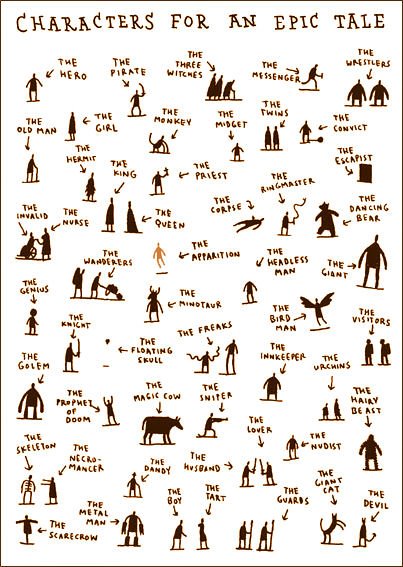
    epic taleUseful reference for all writers. (via Team Forty).

    UPDATE: Thanks to Chris for the link to the artist, Tom Gauld.

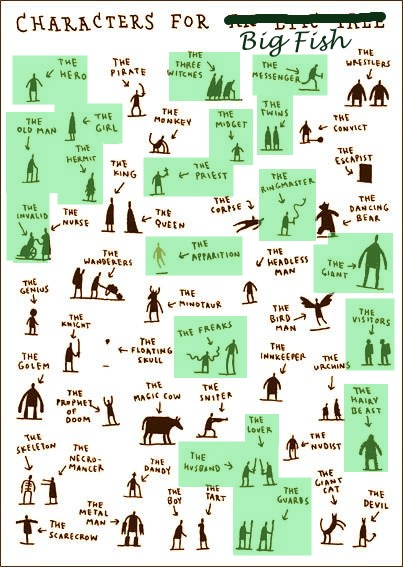
    SECOND UPDATE: Because I was curious…

    big fish tale