

Just noticed that The Nines is now available for rental on iTunes.
Archive for the ‘Screenwriting’ Category
The Nines on iTunes
Friday, April 11th, 2008James Cameron on 3-D
Friday, April 11th, 2008Variety has a terrific interview with James Cameron about current state (and possible futures of) 3-D filmmaking. A couple of things that stood out for me:
Godard got it exactly backwards. Cinema is not truth 24 times a second, it is lies 24 times a second. Actors are pretending to be people they’re not, in situations and settings which are completely illusory. Day for night, dry for wet, Vancouver for New York, potato shavings for snow. The building is a thin-walled set, the sunlight is a xenon, and the traffic noise is supplied by the sound designers. It’s all illusion, but the prize goes to those who make the fantasy the most real, the most visceral, the most involving. This sensation of truthfulness is vastly enhanced by the stereoscopic illusion…
When you see a scene in 3-D, that sense of reality is supercharged. The visual cortex is being cued, at a subliminal but pervasive level, that what is being seen is real.
Seeing U2:3D last month, I agree: the best thing about 3-D is not that it makes things look cool. It’s that it makes things look more real. My favorite shots in the movie are when the cameras look out over the crowd, because you really feel each individual person. Not only are you there, you have permission to stare.
On “Avatar,” I have not consciously composed my shots differently for 3-D. I am just using the same style I always do. In fact, after the first couple of weeks, I stopped looking at the shots in 3-D while I was working, even though the digital cameras allow real-time stereo viewing.
Of course, most directors aren’t James Cameron, who helped invent the technology and can trust his instinct on all of this. But we should trust someone’s instincts, because the result is paralysis. One of pitfalls of adding new technology to film production is that the director moves further and further from the action (and the actors) to a Den of Experts, often in a dark tent, who make decisions around monitors. In most cases, you’re better served by having a d.p. you trust.
We all see the world in 3-D. The difference between really being witness to an event vs. seeing it as a stereo image is that when you’re really there, your eye can adjust its convergence as it roves over subjects at different distances…In a filmed image, the convergence was baked in at the moment of photography, so you can’t adjust it.
In order to cut naturally and rapidly from one subject to another, it’s necessary for the filmmaker (actually his/her camera team) to put the convergence at the place in the shot where the audience is most likely to look. This sounds complicated but in fact we do it all the time, in every shot, and have since the beginning of cinema. It’s called focus. We focus where we think people are most likely to look.
Cameron is slaving convergence to focus, even pulling it as necessary throughout a scene. This makes sense, but I’d never heard it explained so clearly.
The new cameras allow complete control over the stereospace. You should think of interocular like volume. You can turn the 3-D up or down, and do it smoothly on the fly during a shot. So if you know you’re in a scene which will require very fast cuts, you turn the stereo down (reduce the interocular distance) and you can cut fast and smoothly. The point here is that just because you’re making a stereo movie doesn’t mean that stereo is the most important thing in every shot or sequence. If you choose to do rapid cutting, then the motion of the subject from shot to shot to shot is more important than the perception of stereospace at that moment in the film. So sacrifice the stereospace and enjoy the fast cutting.
In front of U2:3D, there was a 3-D trailer for Journey to the Center of The Earth 3D, which I’m sad to say looked like ass. Actually, it kind of looked like nothing, because it was blurry in a way I can’t describe, like my eyes didn’t know how to process it.
I think this is exactly what Cameron is talking about. The 3-D shots in the Journey 3D trailer were probably composed for the movie, where they play much longer. But cut into a conventional trailer, it just didn’t work. (link )
You don’t need to be in 3-D at every step of the way. And as long as your work will be viewed in 2-D as well as 3-D, whether in a hybrid theatrical release or later on DVD, it is probably healthy to do a lot of the work in 2-D along the way. I cut on a normal Avid, and only when the scene is fine-cut do we output left and right eye video tracks to the server in the screening room and check the cut for stereo. Nine times out of 10 we don’t change anything for 3-D.
I spoke with a writer-director during the strike who had the opposite experience. To get the cutting to work right in 3-D, he and his editor were constantly checking the “deep version.” And that’s a not newbie predilection — for Zodiac, David Fincher cut in HD with a giant screen.
No matter how advanced the technology gets, while you’re in the editing room, you’re still working with a rough approximation of what the final film will look and sound like. Just as with color timing, music and FX, anticipating the depth effect is something you’ll need to remember and forget while cutting.
For three-fourths of a century of 2-D cinema, we have grown accustomed to the strobing effect produced by the 24 frame per second display rate. When we see the same thing in 3-D, it stands out more, not because it is intrinsically worse, but because all other things have gotten better. Suddenly the image looks so real it’s like you’re standing there in the room with the characters, but when the camera pans, there is this strange motion artifact. It’s like you never saw it before, when in fact it’s been hiding in plain sight the whole time.
[P]eople have been asking the wrong question for years. They have been so focused on resolution, and counting pixels and lines, that they have forgotten about frame rate. Perceived resolution = pixels x replacement rate. A 2K image at 48 frames per second looks as sharp as a 4K image at 24 frames per second … with one fundamental difference: the 4K/24 image will judder miserably during a panning shot, and the 2K/48 won’t. Higher pixel counts only preserve motion artifacts like strobing with greater fidelity. They don’t solve them at all.
An example of why James Cameron is the Steve Jobs of filmmakers: he understands that what matters is the user experience, not the hard numbers. He also sees how important it is to control the entire process, from shooting through exhibition. The best camera technology is worthless if you can’t get the results you want in a theater.
The good news is that the next generation of moviegoers seems ready to forget that 24fps is how movies are “supposed to” look. And changes within a digital delivery system should be much less painful than the switchover from our current, analog system.
I know it seems like I’ve quoted a lot here, but the interview is long, and there’s a lot more in it about other aspects of the technology which will be interesting to anyone geeky enough to click through.
Quick! Give me a name
Friday, April 11th, 2008Here’s a useful bookmark: click it and it will generate a first name and last name from the U.S. Census data. Refresh to try again.
So far, I’ve ended up with Michael Nickle, Sandra Gray, Jeffrey Silva and Tricia Lenz. Those might not be names for my theoretical deep-sea cowboy, but for That Guy in The Office? Perfect.
Thanks to kottke for the link.
HBO
Thursday, April 10th, 2008Sue Naegle, my TV agent, is the new president of HBO Entertainment. I’ll miss her as an agent, but I’m very excited to see what she does with the network.
Northeaster
Thursday, April 10th, 2008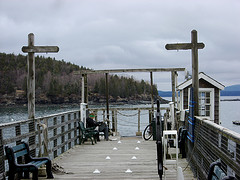 I spent five days in Maine, writing and researching my next project. A few observations, in bullet point form:
Part of my motivation for visiting Maine was that I’ve always claimed to have visited all 48 contiguous states, thanks to endless summer roadtrips with my family growing up. But my mom recently told me that we’d never been to Maine, which kicked in my set-completion instinct.
I was reluctant to try to pronounce any place names in front of people. Bar Harbor is on Mount Desert Island. “Desert” is pronounced like “dessert,” which conjures images of a fantasyland of fudge and sprinkles.
Even though a screenwriter isn’t trying to capture an accent per se, it’s important to choose words and patterns that can work with the accent when spoken by the actor. (”Down the road apiece. Can’t miss it.”)
That said, I feel lucky that this won’t be a big accent movie, because several Mainers were adamant that Hollywood always gets the accent wrong. Which is probably true. But what I resisted pointing out was that no two Mainers I met had the same accent. It’s all over the place, particularly when you talk to people under 30.
Going somewhere to write has become my standard operating procedure. I barricade myself somewhere without TV, internet or familial distractions, and crank through as many hand-written pages as possible in three or four days. I fax these pages back to Los Angeles, both for safety and to let my assistant type them up. This time, I faxed to an eFax account, which had the bonus of creating a digital backup in .pdf form.
I took a lot of photos, which you can see on Flickr. It wasn’t really location scouting — we’re not at that point yet. But since there’s already a director on board, it can give him some sense of the place.
One place had flies. A lot of flies.
Man, I was lucky not to be flying on American. Or ATA. Or SkyBus. Or Aloha. (Though the last one would have been an unlikely choice.)
Another reason for the trip: we had to have our house tented for termites. This is probably alien to readers in colder climates, but in Southern California, termites can become pervasive enough that you need to nuke the house. Generally, you do it when the house is sold (and thus empty), but we’re not moving anytime soon, so we had to bite the bullet. But it looked cool, like a Christo project.
Maine
Thursday, April 3rd, 2008I’m headed east for a very long weekend, so updates are unlikely until Thursday.
Two-hander
Wednesday, April 2nd, 2008 What the heck is a two-handed comedy? Google turns up lots of two-handed comedies, but no one explains what that means.
– jb
I don’t know if Variety invented it, but it shows up in their slanguage dictionary:
two-hander — a play or movie with two characters; ” ‘Love Letters’ has been one of the most popular two-handers of the ’90s.” (See also: one-hander)
It’s worth looking through Variety’s made-up words list to help figure out what the hell they’re saying. In about 10% the cases, they’ve coined a term for something that probably merited a word (”kudocast,” “lense”). The other 90% are just color (”distribbery,” “ayem”).
The term that gets the most play is “ankle”:
ankle — A classic (and enduring) Variety term meaning to quit or be dismissed from a job, without necessarily specifying which; instead, it suggests walking; “Alan Smithee has ankled his post as production prexy at U.”
This is probably an example of the Sapir-Whorf hypothesis: in Hollywood, no high-level executive is ever fired. They simply leave their job. By using a deliberately ambiguous term, Variety maintains the illusion that everything happens by choice.
Trivia: It’s hard to believe, but Variety apparently first coined the term “sex appeal.”
One-sided dialogue
Tuesday, April 1st, 2008I’m writing a script in which a main “character” is invisible and the audience will never see or hear him. The character (Bob) is built from his interactions with the lead character in the story (Jane).
My question is, what is the best way to write dialog between the real and invisible character, when it appears as if the lead character is talking to herself?
Here are a couple examples of what I mean:
- JANE
- I’ve gotta get some food in me. You hungry…? You know I’m a vegetarian– Yeah, so…? Pork rinds are not made of real pig… Fine. You buy me a bag and I’ll read the label.
or:
- JANE
- I’ve gotta get some food in me. You hungry?
- (beat)
- You know I’m a vegetarian–
- (beat)
- Yeah, so?
- (beat)
- Pork rinds are not made of real pig.
- (beat)
- Fine. You buy me a bag and I’ll read the label.
or:
- JANE
- I’ve gotta get some food in me. You hungry?
- (Bob answers)
- You know I’m a vegetarian–
- (he cuts her off)
- Yeah, so?
- (Bob won’t shut up)
- Pork rinds are not made of real pig.
- (he begs to differ)
- Fine. You buy me a bag and I’ll read the label.
Do you think one of these options is better than the others? Do they all suck? I’d appreciate any suggestions from your own experience.
– Michael
Los Angeles, CA
You’re bumping up against one of the limitations of screenwriting: it’s hard to capture some things on paper that make perfect sense on screen. You’re trying to balance clarity with annoyance, so the reader will understand what’s happening without being aggravated by the technique.
Option one is just too dense. Option two is much easier to read, but you’re beating us to death. And option three provides more detail than we really need.
So my suggestion would be to try a combination of options two and three. Use (beat) or another short, meaningless filler such as (listens) or even (. . .) for most breaks, then provide more details (such as “he begs to differ”) on lines that need the setup.
Also, consider how often you really need to break up the lines, and look for occasions when it makes as much sense to keep them together.
It’s never going to be ideal. But if your dialogue is sharp enough, the reader will ignore the parenthetical awkwardness and enjoy the rhythms you’re setting up. That’s all you need.
Post-strike update
Tuesday, February 26th, 2008Last night I went out for beers with my picketing team from the Van Ness gate. I hadn’t spoken with any of them since the end of the strike, so it was nice to catch up, and see them in clothes not specifically chosen for walking in the cold.
Remarkably, it was the first conversation I’d had about the strike in over a week. After three months of talking (and blogging) about nothing other than the AMPTP, the NegComm and picketing schedules, it’s surprising how completely the strike has vanished off the radar.
With the official contract ratification results due today, it feels like a good time to take stock of where various projects have ended up in a post-strike universe.
The web series
We’re finishing editing on the web pilot I shot at the start of the month. Once it’s done, the financiers will go off and look for distribution and advertising partners. If we can find the right combination, we’ll aim to shoot a block of episodes this summer.
Shazam!
I spent the weekend barricaded at the Disney Grand Californian working on the next draft of Shazam! I’d gotten the studio and producer notes just before the strike, so this was my first chance to address them. It was great having a three-month break from the script, because it meant I could look at it with fresh eyes.
There are some web reports out of WonderCon about a possible title change to something longer and more Harry Potter-ish. Nothing’s decided yet. Obviously, one of the challenges with the property is that an audience will automatically assume that the hero’s name is Shazam, when it’s not.1
Dreamworks project
When the strike began, I was halfway through the first draft of an unannounced project for Dreamworks, with a major star and director involved. Without being too specific, Something Happened unrelated to the strike which made it very unlikely that our movie could (or should) get made. So one of the first conversations I had after the strike was with the producer and director to figure out whether or not to proceed. After about 15 phone calls, many involving agents and executives, the decision was made to kill the project.
It was the right choice. While it’s hard to walk away from 55 pages, finishing the next 55 while almost certain that they could never be filmed would be even more dispiriting. As I write this, it’s not clear whether I’ll segue into a different project for the studio, or just write them a check for the money they’ve already paid me. Either way, I feel better getting to work on a script that is much likelier to become a movie.
Heroes: Origins
My hunch is that this spin-off series will stay in the deep-freeze for a while, maybe never to be thawed out. Tim Kring has said in interviews that the priority is getting next season’s plotline (”Villains”) ready for launch, as it should be. If Origins is resurrected at some point, I’d be happy to direct my episode.
- Shazam is the wizard who bestows his powers; the guy in the cape is Captain Marvel. For legal reasons, the movie can’t be called Captain Marvel. ↩
Scripting a short film
Friday, February 22nd, 2008I’m about to get cracking on my submission for a prestigious short screenplay competition. I wondered if you had any advice specific to writing shorts? If you were judging a shorts competition, what would you be looking for?
– Kirsty
York, UK
A short film, like a short story, can’t waste any time. You need to give us your principal characters and establish their motivations immediately. There’s very little stage-setting before you get to the inciting incident and the ensuing complications.
The hero’s fundamental problem/challenge/obstacle needs to occur by the time you get to the 1/3rd mark. So, if your short is meant to be three minutes long, the big event needs to happen on page one. If it’s a 10-minute short, it happens around page three. It’s not that you’re worried about your reader getting bored before then — if you can’t entertain us for three pages, there’s a problem — but rather that if you delay any longer, your story is going to feel lopsided: too much setup for what was accomplished.
Beyond that, I wouldn’t worry much about traditional structural expectations. Funny almost always works better than serious for a short, because there’s not enough time to create the narrative movement you expect in drama. But there are exceptions. The Red Balloon for example. And I loved Walter Salles’ chapter in Paris, je t’aime, which was simply a sad rhyme.1
So think funny, or poignant — but only if French.
I’ve put the script for my 1998 short film God up in the Downloads section.2 It’s 30 scenes in 11 pages. A lot of story happens, quickly. But many successful shorts take the opposite tack: they’re essentially just one joke, fully exploited. Todd Strauss-Schulson’s Jagg Off is that kind of short, as are most of the SNL and Will Ferrell videos you’ve seen.
For the competition you’re entering, however, I’d be careful not to submit anything that felt too much like a comedy sketch. If I were a judge, I’d be looking for a script that doesn’t seem like it could end up on Saturday Night Live. (Or the British equivalent.)
Good luck!


