 |
Archive for the ‘Screenwriting’ Category
Thursday, May 15th, 2008
This morning’s decision by the California Supreme Court means I no longer have to be an unwed father. And for a change, even our Governor is onboard:
I respect the court’s decision and as governor, I will uphold its ruling. As I have said in the past, I will not support an amendment to the constitution that would overturn this state supreme court ruling.
Granted, he could have simply signed his name on bills when I asked him, but better late than never.
His quote refers to the dark cloud on the horizon, a ballot initiative to amend the state constitution, which is pretty much the only way to overrule the court at this point. But that’s tomorrow’s fight.
As it stands, I’m planning on getting hitched this summer. It’s been a very long engagement.
Posted in Screenwriting | No Comments »
Tuesday, May 13th, 2008
Based on my score in this list of 1001 important books, the answer is no.
I got 38.
Some disclaimers are in order. First, the list includes only fiction. If it included non-fiction, I’d score much higher. I only counted books I actually read — seeing the movie doesn’t count. The list makes some questionable choices (The Lord of the Rings trilogy counts as one book, while Alice in Wonderland/Through the Looking Glass is two), and some notable exceptions (Dune, anything by Faulkner). But there were enough titles that I recognized and hadn’t read to make me feel a bit ashamed.
The list comes from 1001 Books You Must Read Before You Die , a title that mixes death, forced labor and literature in a way that’s not particularly appealing. But I’m sure the editor explains his biases somewhere in the book. , a title that mixes death, forced labor and literature in a way that’s not particularly appealing. But I’m sure the editor explains his biases somewhere in the book.
By all means, share your score and criticisms in comments.
(Original link via Jason Kottke.)
Posted in Screenwriting | No Comments »
Monday, May 12th, 2008
I’ve written about the importance of a good title before. A great script with a crappy title faces an uphill battle. That’s why I always make sure I have a title I like before I type “FADE IN,” even if I later change my mind.
So yes, I’d pay for a great title. Today’s LA Times article about companies that consult on movie titles sounded promising, until…
Last summer, Lockhart and Barrie tried to persuade Sony to change the title of “Hancock,” a big-budget action comedy starring Will Smith as an alcoholic superhero known as John Hancock. They told studio executives they thought the current title was vague and pitched alternatives such as “Heroes Never Die,” “Unlikely Hero” and “Less Than Hero.”
There’s spit-balling, and then there’s just spitting. I’d rather have an inscrutable one-word name than any of those crappy alternatives.
I helped out on that movie as it was transitioning from “Tonight, He Comes” to “Tonight He Comes” — the removal of the comma helped soften the double-entrendre. But by the wrap party, it was simply “Hancock,” which serves it well.
By the way, the Josh Friedman who wrote the LA Times article is not the Sarah-Connor-Chronicling neighbor and erstwhile blogger.
Posted in Screenwriting | No Comments »
Saturday, May 10th, 2008
I’ve added two .pdfs to the Library. (Which is the rechristened “Downloads” section. Thanks to whichever reader suggested renaming it.)
The visual FX breakdown for two of the sequences — the end of Part One, and the end of Part Three. Both are spoilers, so skip them if you haven’t seen the movie yet. The shooting schedule. This is pretty close to how we ended up doing it.
Shooting schedules are hard to read if you’ve never looked at one, so let me talk you through it.

Starting at the left is the strip number. Because some scenes may have more than one part — for instance, a visual effect in addition the main action — you sometimes (rarely) need to refer to the strip rather than the scene number.
Next is the scene number. For The Nines, we numbered all of the Part One scenes in the 100s, Part Two in the 200s, and Part Three in the 300s. Most movies would just go sequentially from 1. Read here for more info on scene numbers with letters.
The third column is a short description of the scene, along with INT or EXT, DAY or NIGHT. Note that the line producer or AD writes this description, so it’s not always what the writer would pick.
Fourth column is the length of the scene, measured in eighths of page.
The final column shows which characters are in the scene, by number. Generally, your most important characters are given the lowest numbers, with preference for the bigger stars. In the case of The Nines, our numbering system went as follows:
- Gary/Gavin/Gabriel = 1/5/18
- Margaret/Melissa/Mary = 2/7/19
- Sarah/Susan/Sierra = 3/6/20
To see how much work is scheduled on a given day, look down to the divider strips, marked “– END OF DAY…” This tells you how many pages you’re expecting to shoot.
As you’ll see, we shot 4-5 pages a day — fairly ambitious for a feature, though indies tend to shoot more pages per day simply because limited budgets mean short schedules.
You can find both documents here.
Posted in Screenwriting | No Comments »
Friday, May 9th, 2008
“Paul from LA” wrote in with this link to a site I kind of remember using when we were picking a name for my daughter. It lets you type in any first name and graphs how popular it has been (in the U.S.) over the past 130 years. What’s less obvious is that if you hover over the graph at any point, it can show you a name’s rank in that year.
For example, here’s John, which has fallen from #1 to #20.
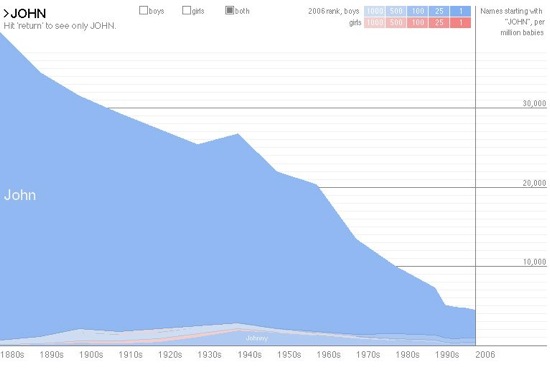
It’s worth a bit of time-wasting to see how names come and go.
Posted in Screenwriting | No Comments »
Thursday, May 8th, 2008
Y’know, I think we learned something today: Derivatives were maybe not the best choice for the third-ever scene challenge.![[Scene Challenge]](http://johnaugust.com/Assets/scene_challenge.png)
I deliberately picked something tough because in real life, screenwriters are often faced with challenging topics to explain. For example, last night I spoke with Ron Bass about the Einstein project he’s working on. Quick: Show special relativity.
But this wasn’t much easier. Readers tried hard to find a way to make these abstract financial instruments cinematically explicable, but it proved tougher than expected. First, you had to find a scenario in which derivatives would make sense. Then you needed to craft an explanation that didn’t read like a Wikipedia summary.
That’s assuming you really understood what derivatives were, and after reading 84 entries, I think I understand them less. In the end, I was happy to accept any of the sub-categories (options, futures, forwards), but kept hoping for more entries where the concept of a derivative was really key to the story, and not a throwaway bit of dialogue. That’s why I threw in my own piece of Angel fan-fic.
That said, I was happy to see that most of the entries didn’t take place on Wall Street, but rather ranged from fantasy (Alan Scott) to bachelorhood (Andy).
“John August” was introduced as an element in a surprising number of scenarios, a meta-quality that helped break up the sameness, but didn’t win any ribbons.
Jonathan, however, brought up an interesting and obvious analogy I’d overlooked:
- ACCOUNTANT
- Why don’t you just ask your blog readers to explain it for you?
- JOHN
- I’ve already tried that. You should have seen the dreck they wrote back. Besides, what do I pay you for?
- ACCOUNTANT
- (sighing)
- When a studio wants to buy your script, but doesn’t want to risk all their money, what do they do?
- JOHN
- They option the script, so they can buy it at a future date. Crafty devils.
(Jonathan also put me in a jacuzzi with grape-feeding starlets, which suggests he might not know my biography that well.)
Juicy Lucy found a good example of a character whose entire existence seems to be a pitiful derivative:
- A COUGH from across the table causes Popeye and Olive Oyl both to look up, but their companion’s face hides behind his open newspaper, whose headline reads:
- PRICE OF BEEF EXPECTED TO PLUMMET BY THE END OF THIS WEEKEND
- The newspaper lowers to reveal WIMPY, his yellow top-hat perched precariously on his fat head, his already thin mustache stretching even further when he shoots a sh*t-eating grin at the approaching WAITRESS…
- WIMPY
- I’ll gladly pay you Tuesday, for a hamburger today.
I liked how Unkatrazz made the distinction between a stock and derivative:
- PAPERWEALTH
- Why buy an investment…when you can make a bet on an investment?
Having a character explain his job was a natural choice for many readers. The best of these was Jacob’s:
- Next date: Girish is animated. He holds a coffee cup and moves it around the table as he speaks.
- GIRISH
- Say there is a farmer growing coffee beans in Karala. It’s late July and harvest is still six months away. The problem is that market prices for coffee go up and down for reasons out of his control. In six months, prices could be higher than they are now, which would be lovely. But if prices are lower, he stands to lose his farm. In order to protect himself, he gets together with other farmers in the same position and signs a contract to sell tomorrow’s beans for today’s prices. He gets a little money now, and then when the contract comes due, he sells the beans to the buyer for the agreed-upon price.
- Girish pauses, then speaks with emphasis.
- GIRISH
- Betting that prices will rise, I am that buyer.
Many entries took a glancing shot at derivatives, without really trying to explain them. Of these, Andy’s was a favorite:
- Scrawny BILL GATES (19) signs a contract in black ink.
- BILL GATES
- We’re in the 70s. Nobody signs in blood anymore.
- He smirks at SATAN (?), who fidgets nervously.
- SATAN
- I don’t get it.
- BILL GATES
- It’s basic finance. Derivatives. By the time you get my soul, it could be worth a lot more.
- SATAN
- Or a lot less.
- BILL GATES
- But you’re getting it cheap now. Look, either way you get it. You’re covered.
- SATAN
- Erm… I don’t know…
- BILL GATES
- Tell you what. I’ll throw in some stocks to sweeten the deal.
- BILL GATES offers him the pen. Satan hesitates.
- SATAN
- Ah, fuck it.
- He signs, and at that very moment, a new Circle is carved into Hell.
Crimeland figures played a role in many entries. Mike Lavoie gets credit for working the most financial terms into a threat:
- BURGER
- There are four kinds of derivatives, Frank. Forwards, which is the direction we can move in now. Options, which you’re running out of. Futures, a couple of which you can decide now. And finally: swaps. As in: You give me my money and, in exchange, you get the rest of your wife.
The two top finishers come from the other side of the crime equation, with police-types investigating derivative wrongdoing. David Nemesis:
- INT. BRANT BUILDING LOBBY - DAY
- Eckes and Rosenfeld are walk-and-talking to Rosenfeld’s office.
- ECKES
- Stop, you lost me. What was Laszlo dabbling in?
- ROSENFELD
- Weather derivatives. Let’s say you’re Gruber Foods. Your bottom line depends on a good wheat harvest, there are any number of things that can mess that up, and you want to hedge your bets. So you buy up some weather futures.
- ECKES
- Okay. Wait, what?
- ROSENFELD
- Weather futures. They’re like an insurance policy on the weather, only no insurer would be crazy enough to put money on the weather. So you go to an options exchange and find someone who’ll sell you a contract that guarantees you a payout if certain things that aren’t likely to happen do happen.
- ECKES
- Like a snowstorm in the middle of Kansas in July?
- ROSENFELD
- Well…I’m sure they were thinking more along the lines of a few days of extra rainfall over a 60-day period. But yeah, pretty much. It’s all about variations from the norm. The seller’s taking a calculated risk that their forecasts will be close enough to accurate that they’ll get to keep all the money from the sale.
- ECKES
- So Laszlo was buying insurance policies which paid out if the weather did something unexpected?
- ROSENFELD
- Precisely. It’s a great investment opportunity if you just happen to be able to control the weather.
- ECKES
- Yeah, well, something tells me the folks in the derivatives market don’t know about super powers yet.
And this from Anthony:
- AGENT
- Your husband was leading something of a double life. Did you realize he was into derivatives?
- WOMAN
- (shocked)
- You mean … like transvestites or something?
- (a beat)
- AGENT
- No ma’am. Derivatives. They’re financial instruments - futures, forwards, options.
- (beat)
- Sort of like stocks, but you’re buying the right or the obligation to make a transaction in the future. Your husband was trading derivatives online. Mostly options.
- The woman stares blankly.
- The Agent picks up a book from the couch - “Taste of the Town 2008?. It’s one of those coupon books school kids sell for fundraisers.
- AGENT
- Like the coupons in this book.
- (shows her a page in the book)
- This Burger Bonanza coupon here - “Any sandwich for 99 cents during the month of December”. That’s like a derivative. When you bought this coupon book you purchased the option to buy an item for a set price at a set time in the future.
- WOMAN
- I think I liked it better when he was just surfing the Internet for porn. At least my furniture didn’t disappear then.
In the end, I’m giving the imaginary award to Anthony for the coupon book metaphor. Well done. He can claim his bragging rights in the comments section.
Thanks to everyone who entered. I promise next time, it will be something a little more fun.
Posted in Screenwriting | No Comments »
Wednesday, May 7th, 2008
 I am a reasonably successful screenwriter. A working writer. I’ve sold two pilots, gotten a freelance episode of a high-quality one-hour drama, done some comic book gigs, and just sold a feature with myself attached to direct at a production budget of $3M. I am a reasonably successful screenwriter. A working writer. I’ve sold two pilots, gotten a freelance episode of a high-quality one-hour drama, done some comic book gigs, and just sold a feature with myself attached to direct at a production budget of $3M.
Not A-list, or B-list, but maybe C-minus working my way up. I’m in my early thirties and have been at this a couple years.
My problem/question is: I feel like I have hit a wall with respect to my sense of story. I feel like most of my success has been gotten on a combination of ability-to-pitch, charisma and the ability to turn a phrase inside a scene. But I have this real weakness when it comes to knowing what the right scenes are in the right order. Story. Plot. I can put two people in a room and have them riff in a pleasing and entertaining way and to the extent that my story supports this kind of loose, Kevin Smith-esque writing, I do well.
But I know that if I want my career to go to the next level, I need to improve my understanding of story and plot.
So I guess I have two questions…
1) Any ideas on how to do this on an intermediate/advanced-level? How can I go from a “B” understanding of story/plot to an “A” understanding of story/plot?
and
2) What are your thoughts on how to keep making breakthroughs in the quality of your work when you are at an intermediate/advanced level? Do you feel like you are constantly improving? How do you keep improving?
– Scott
Los Angeles
You’re already the envy of most of the readers of this site: you’re a working Hollywood writer. So congratulations, and don’t dismiss what you’ve accomplished. I’m happy to hear you attribute it your skills (pitching, wit) and not pure dumb luck.
So let me offer some good news. The stuff you’re not especially good at — story, structure, plot — can actually be learned. If you were writing in for advice about how to be funnier or more charismatic, I would have probably let your email sit in the growing folder of unanswerable questions, because those are pretty much inherent qualities.
My advice for you is to dedicate one day a week to disassembling good movies. Take existing films (and one-hour dramas) and break them down to cards. Think of yourself as an ordinary mechanic given the task of reverse-engineering a spaceship. Figure out what the pieces do, and why they were put together in that way.
Here are the questions you need to ask about each scene or sequence:
- As the audience, what am I expecting will happen next?
- What does the character want to do next?
- Is this a good moment to let the character achieve something, or knock him back?
- How long has it been since we checked in with other character and subplots?
- What would have happened if this scene had been cut? Or moved?
By asking these questions about other people’s movies, you can take some of the pressure off.
When it comes to your scripts, it might be worth writing something that’s deliberately outside of your comfort zone, a script that doesn’t let you rest on your scenework. Because to answer your second question, yes, I think you can keep making breakthroughs in your writing, but only by challenging your preconceived limitations.
I’m currently writing my first period movie, my first stage play, and my first stage musical. Part of the reason I’m enjoying them is because they scare the be-Zeus out of me. I’ve passed on some more obvious projects that I’m sure I could have written competently simply to stretch a little more.
Yes, I’m deeper in my career than you are. And my flitting from genre to genre has probably hurt me in some respects. But a career isn’t one script, or ten, it’s the years of your life. You’re working. Your ability to turn clever phrases won’t go away. So you’re right to focus on the areas you think you can improve, if only to increase your confidence and enjoyment of the career you’ve chosen.
Posted in Screenwriting | No Comments »
Monday, April 14th, 2008

Derek Frey recently traveled back to Montgomery, Alabama, and took some great shots of the remaining sets from Big Fish. You can see them all here.
Posted in Screenwriting | No Comments »
Saturday, April 12th, 2008
foot clutter: the tendency for people’s feet to get stacked up unnaturally when combining single shots together to form a group shot.
Example:

This is from the promo materials in development for the web pilot. Each character needs to be in its own layer, so they can stack up for animated graphics.
Posted in Screenwriting | No Comments »
|
|
|


