At first glance, the screenwriter who gave the world Troywouldn't seem like the natural choice to adapt a literary novel of childhood joy and adult challenges. But David Benioff isn't just the writer behind brawny action films like Troy and the upcoming Wolverine: Origins; he's also a novelist, who adapted his own book for Spike Lee's brilliant, overlooked 25th Hour. After screening The Kite Runner at the closing night of the Mill Valley Film Festival, Benioff spoke with a roundtable of journalists in San Francisco about collaborating with novelist Khaled Hosseini, the challenge posed by certain cultural differences and the combination of brute force and finesse required to fit an epic novel onto film. Cinematical's questions are indicated.
I guess I'll start with the obvious question, which is: Given that this is a film about a culture completely different from our own, how instrumental was it having (author Khaled Hosseini) on-hand to support you?
David Benioff: It was a great help, and I think I got really lucky, because I've had friends working on adaptations where the relationship between the screenwriter and the novelist is ... tense. And sometimes you have a writer who writes a book and sells the film rights and says "Thank you for the money ..." and just doesn't want to be involved -- and sometimes they want to be so involved -- I can think of examples, like the Sahara guy. (Clive Cussler).
But in this case, Khaled (Hosseini) was both very supportive, but very understanding that the movie was going to be very separate from the book. And he was a great resource; I mean, I could do as much research as I wanted and read books about Afghan history and so on, but I'm not from there, I'm not a Muslim, I didn't grow up in Kabul ... and to be able to call Khaled or e-mail him -- it was mostly a lot of late night e-mails -- and then to wake up in the morning and to have a response from him, a very detailed response from him, explaining what the movie theaters were like in Kabul in the '70s, or what the protocol would have been in a certain situation ... it was a great resource. It was incredibly helpful, and I think it made the script much better than it would have been otherwise.
Cinematical: Obviously, you have a very good relationship with Mr. Hosseini -- and this is not asking you to speak ill of the book -- but what in the book made you roll your eyes, thinking "God, I don't know how you bring this to the screen?"
DB: I don't know if there's a moment, particularly, or just the length of certain sections. For me, when I was reading the book, I was completely captivated by the childhood scenes in Kabul and then felt maybe a slight loss of momentum in the American scenes. You know, many of the (American) scenes I actually love -- and many of them are in the movie -- but I felt like I had to compress that. There's no way to keep as much of the early childhood stuff as we did keep from the book and keep as much of the American things without the movie veering into (a length of) three hours and 30 minutes.
So for me, it was really compressing the American scenes in the center section there, and a lot of compression at the end; at the end of the book, after the climactic fight with the Assef in the Taliban compound and they flee into Pakistan -- then a whole other plot starts, where they're trying to deal with immigration, and dealing with an INS (Immigration and Naturalization Service) official, and that was never in the script. It was really a decision partly because of time, and partly because I felt like once we had the climax, having another 45 minutes of story time post-climax ... I felt like I would be wriggling in my seat. It just felt like, structurally, it would be a mistake.
Just the other day, Christopher Campbell posted that Mary Steenburgen and Sissy Spacek had signed on to play two of the moms in next year's holiday pic, Four Christmases. The movie stars Reese Witherspoon and Vince Vaughn as a couple who try to see their four divorced parents on Christmas day. This latest piece of news isn't who the other father is (Robert Duvall is playing Vaughn's dad), but rather some rumored trouble on the set between the two stars -- who play the couple that's supposed to be sticking together.
According to the Daily News' Gatecrasher, the screen couple definitely haven't been getting along, and won't be the follow-up to Vince's romance with past co-star Jennifer Aniston. Just like her production company's moniker (Type A Films), Reese is coming to set ready to put in lots of work, while Vaughn wants to be laid-back. "Vince rolls onto set in the morning looking like he just came in from a night out, while Reese will arrive early, looking camera-ready. Then, Reese tries to force Vince into blocking out each scene and running through their lines as Vince tries to convince her that he's an ad-libber and wants to play around and see where the scene goes."
So far, however, this clash hasn't stopped production, but the source also says that Vaughn sometimes looks like "he just wants to kill her." Honestly, I can see both of their points. I'm sure it must be aggravating for Reese to have to fight to get cooperation in how she prepares, just as it's probably infuriating to Vaughn to deal with a Tracy Flick-type and not be able to just go along as he wants. Hopefully it won't lead him to the fate of Matthew Broderick in Election. We'll have to wait 12 months and see whether we can spot all that anger in their characters; if the rumors are true, we'll see just how good the two actors really are.
Just how strange are the Golden Globes? Is Atonement a sure-fire, dead-lock Best Picture winner, or has it stumbled with the Academy before the race was even begun? Did Francis Ford Coppola "cut his own throat" with the release strategy for Youth Without Youth? And, speaking of cutting throats, will Sweeney Todd seduce the Academy, or have its hopes been washed away with the arterial spray?Joining James this week is David Poland, the critic, blogger and raconteur behind Movie City News as well as the wildly contentious, always insightful The Hot Blog. Listen in this week as James and David talk about the BFCA nominations from the inside, discuss the tarnished-yet-telegenic schizophrenia of the Golden Globes, and much more! And finally -- new this week on for The Rocchi Review -- you can listen directly here at Cinematical by clicking below:
Born in Afghanistan in 1965, Khaled Hosseini left in 1976 as his family was relocated to Paris as part of his father's work for the diplomatic service. It was fortunate timing; while preparing to return to Kabul in 1980, the Soviet invasion of Afghanistan plunged the nation into decades of chaos some would suggest it has yet to emerge from. Gaining political asylum in America, Hosseini's family moved to San Jose, California; after attending medical school, Hosseini worked as doctor in Los Angeles -- and wrote his first novel. Not only was The Kite Runner published, but it was on the New York Times best-seller list for over two years, and eventually printed in over 42 languages. Now, after years of development and no small share of controversy, The Kite Runner has come to the silver screen; after screening the film for the closing night of the 30th annual Mill Valley Film Festival, Hosseini spoke with a roundtable of journalists in San Francisco about the challenges of adaptation, the genesis and possible fallout of the film's controversial scene of sexual assault and his own memories of Afghanistan. Cinematical's questions are indicated.
Cinematical: What did you learn about the process of movie making going through this experience?
I underestimated the sheer amount of labor it takes to shoot the seemingly simplest scene, just the amount of work that goes just into setting up a scene and how each member of the team has to do their job exactly right, otherwise the whole thing falls apart. It's very labor intensive. It's also very monotonous. It's exciting in a way, but -- you're doing the same thing over and over and over again. So there's a sense of monotony. I underestimated how exhausting it was. The hours are very long and physically it's very demanding. I don't know how some of these guys do it for 10, 20, 30 years, especially the crew. It's a lot of hard work. How involved were you in the process?
I was kind of a cultural consultant, a story consultant. Maybe the best way to illustrate it is with an example; I went to L.A. and sat in an office with the producers and we looked at hundreds and hundreds and hundreds of pictures that a scout had taken around the world. And they wanted me to kind of chime in and say if there was any locale that could be used to as stand in for 1970s Kabul. And we looked at Turkey and Tunisia, Morocco and India, Pakistan, but western China, the minute those pictures started coming up, I said, 'This place.' So they went out there and the Afghans who have seen the film are startled at the resemblance.
So that kind of thing - questions about dress, about food, about the way a home is decorated, a variety of things of that nature. But I didn't write the screenplay. Obviously, David (Benioff) did. I read the screenplay and we all kind of chimed in our ideas and David wrote another draft, but really it's his creation.
How do you feel the film captures Amir's betrayal of Hassan, the scene where the boy is attacked? From the work you had do creating that scene, how do you feel about seeing it on screen?
I think the scene was shot tastefully. I think in other hands, it could have really been exploitative, kind of graphic, and I don't think there's any need for that. When the boy walks out of the alley and you see the droplets of blood in the snow, I always feel this incredible moment in the audience where they go, 'Oh!' Suddenly, it elevates the film to another level. The stakes are raised at that moment. It's really a devastating moment.
The main gate at Paramount was more packed than I’ve seen it all strike, and featured some familiar names and faces, both at the podium and in the crowd. Speakers included Howard Rodman, Robin Swicord, Bill Condon, and Harlan Ellison, who filled in for a muted Josh Olson. I wasn’t brave enough to introduce myself to Sarah Silverman, but did get to talk with Iris Yamashita (Letters from Iwo Jima) and Diana Ossana (Brokeback Mountain).
As with most gates, there were a number of blog readers and film students. Thanks for continuing to come out to the lines.
On Monday, I’ll be back at my usual post: 5:30 a.m. at Paramount’s Van Ness gate. That’s the last day of normal studio picketing before the holidays.
Yesterday, I braved Actual Sunlight to speak at the Indie Gate gathering at Paramount. It was a great turnout, with a collection of writers expressing a range of opinions, from moderate (me) to far less than moderate (Harlan Ellison).
I’ll have a full recap of the day up later, but I wanted to post what I (more or less) said while I could still reconstruct it.
A few weeks ago, I got involved in a pretty heated discussion online, talking about one issue that screenwriters think about a lot. Namely, where would you go if Los Angeles were suddenly overrun by zombies?
There are many good options. If you can get to Angeles National Forest, great. The desert is another possibility. But if you’re stuck in the city itself, I’d propose a good choice would be one of the movie studios. They have big walls and defensible gates.
They’re really the castles of Los Angeles.
And to an outsider, seeing us here today, it might look like we’re villagers trying to storm these castles. Like this is a siege. But that’s not really accurate. We’re not trying to get in — we’ve been inside, and really, it’s not that nice. Rather, we’re here because we want those guys to come out. We’re not here to bring war. We’re here to make peace. And we can’t do it alone.
The theme behind today’s gate is “Independent Film.” But I think we all know that’s a misnomer. We might write our scripts independently, but shooting them requires the cooperation and hard work of a crew, producers, and financiers.
And over the last few years, companies like Paramount Vantage have taken a big interest in our movies. Yes, some of them make money, but more importantly, they make the studios look classy. It’s no accident that most of the movies “For Your Consideration” were first considered in our heads. First written with our hands.
If anything, we should be calling it “co-dependent film.” We’re good at making movies. They’re good at releasing movies. Yes, we have a fucked-up relationship — but it’s a relationship. And we’re here every day because we want to make it work.
I have a blog, and every day I’ve been writing up what happens on the picket lines. One of the things I never anticipated is how many non-WGA writers would be joining us. I like when they sign-in as “Future WGA.” Because they’re recognizing that what gets decided through this strike will be the contract they’re working under for the next 20 years. So I want to give a shout-out to them now. [cheers]
What they see — what we all need to remember — is that however long this strike goes, it’s nothing compared to the 20 years ahead. These studios, these castles, they’ll probably be here. We want to make sure writers are too.
There's a piece of video being hosted over at Slashfilm that came from a Youtube guy who digitally messed around with the sound levels on Sofia Coppola'sLost in Translation, and claims to have uncorked the movie's biggest secret -- what is being said to Scarlett Johansson by Bill Murray in that famous final scene. I'm not going to give it away here, but I'm not even sure this spoiler is legit -- even amplified as best it can be, the words still require subtitles for you to follow along and it doesn't even seem like that's what Bill Murray is saying. The first part is especially a stretch I think, although I'd probably guess the last part is more or less accurate. And I will concede that it does seem like something that Murray's character would say and something that Coppola would write -- it's not, as some expected, Murray telling Johannson what he had for lunch or anything.
Lost in Translation was not my gateway film into Coppola -- for me, it was Marie Antoinette, so for me, this isn't some major cinematic mystery that I was dying to solve in the first place. I'm more concerned with the how and why Marie Antoinette got completely shafted at the Academy Awards and I look forward to the day when the Academy makes up for that huge mistake. Coppola will one day be recognized as a chip off the old block and hopefully, she'll also have more productive years and less time in the cinema wilderness than her pops. Check out the Lost in Translation video after the jump ...
Before viewing (or reviewing) The Kite Runner, the big screen adaptation of Khaled Hosseini's best-selling novel, try a brief word-association test. Here's the key phrase:
Afghanistan.
What was the first thing that came to your mind? War? Opium? The Taliban? Terrorism? Perhaps, and there's no fault in that. However, if you're one of the many who've read Hosseini's book -- and kept it on The New York Times Best-Seller list for over two years -- you may have had a different set of associations: Families. Tragedies. People. And that is why Marc Forster's adaptation of The Kite Runner is worthy of at least a little praise, not only as a sensitively and beautifully made film but also as a deliberate attempt to reclaim Afghanistan -- and the Afghan people -- from an image that we in the West have crafted mostly from brief news reports of trouble or newspaper articles explaining a broken nation's shattered past.
Amir (Khalid Abdalla) is a writer; he lives with his father Baba (Homayoun Ershadi) in California, and they find some sense of belonging in the Bay Area's exile Afghan community, trying to move forward while respecting the past. Amir's written his first book -- his father wants him to take up something sensible -- and is married to Soraya (Aossa Leoni). And then there's a phone call. It's an old friend of the family, Rahim (Shaun Toub); he wants, he needs Amir to come back home. Amir left when he was a boy, during the Soviet invasion; his life is in America now. But Rahim explains why Amir has to come home, and finally convinces Amir with one simple phrase: "There is a way to be good again." Flashing back, we see Amir's boyhood in Afghanistan: His father is a hard-working member of the secular upper-class; his best friend is Hassan (Amad Khan Mahmoodzada), the son of the house servant -- and young Amir (Zerekia Ebrahimi), motherless but not unloved, wants to be the best kite-fighter in Kabul. Meanwhile, Baba's faced with Afghanistan's challenges: "The fanatics want to save our souls, and the communists tell us we don't have any. ..." It's a glib line muttered over a drink for Baba; it's about to get a lot less funny.



 Just the other day,

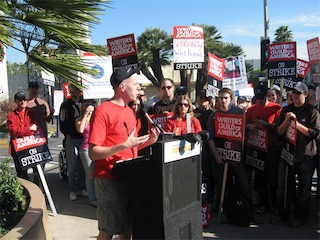 Yesterday, I braved Actual Sunlight to speak at the Indie Gate gathering at Paramount. It was a great turnout, with a collection of writers expressing a range of opinions, from moderate (me) to far less than moderate (Harlan Ellison).
.jpg) There's a piece of video being hosted
There's a piece of video being hosted 


